










































Widening Cracks in Patriarchy: Mothers and Daughters Navigating Gender Norms in a Mumbai Slum
London School of Hygiene and Tropical Medicine (Cislaghi, HeiseMartine Collumbien); International Centre for Research on Women (Bankar, Verma); Johns Hopkins Bloomberg School of Public Health (Heise)
"My neighbours would say that a girl like me is full of herself, that she will be out of control, this and that. They would tell things like these to my mum....My mum would say that leave it, let her be the way she wants to be."
Inequitable gender norms can be particularly harmful to girls and young women, sustaining practices, such as child marriage, that threaten their health and wellbeing. Gender-transformative interventions seek to reshape relations so they become more gender equitable, benefiting both men and women by freeing them from the oppression of destructive gender norms. This qualitative study reveals how Parivartan, a sport-based intervention in Mumbai, India, helped families in an informal settlement resist inequitable gender norms that limited girls' mobility in public spaces.
The Parivartan programme (see also Related Summaries, below) was located in four plots at the periphery of Shivaji Nagar, one of Mumbai's largest urban informal settlements. The community consists predominantly of Muslim migrant families working in the unorganised sector and living in substandard housing with poor water supply and sanitation. Public spaces are dominated by men, and, after menarche, girls' mobility and visibility are restricted, as is their interaction with boys. Burkhas or salwar kameez with a headscarf are the requisite dress code outside the home.
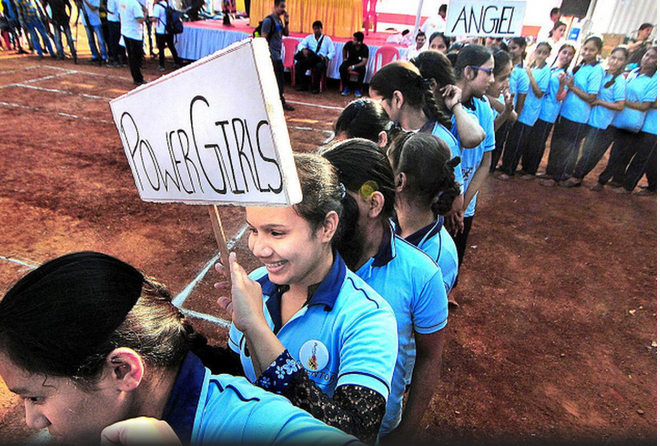
In that context, Parivartan sought to facilitate family capacity to resist the system of gender norms that helped sustain child marriage, also helping family members reframe their gender relations and dynamics. Implemented by the non-governmental organisation (NGO) Apnalaya between December 2014 and March 2016, Parivartan adapted the contact sport known as kabaddi as part of a strategy to challenge gender norms around mobility and stereotypes about what girls can do and achieve. The choice of kabaddi was guided by community members themselves (girls, parents, other men and women in the community, and NGO representatives). Apnalaya recruited and trained 15 mentors, young women from the same community, who were trained to facilitate reflective conversations on gender equality and to coach girls as kabaddi athletes. Girls aged 12-16 (n = 138) met twice a week: once on Sunday to play kabaddi and once during the week to participate in life skills and gender mentoring sessions. While separate adult sessions were planned for both mothers and fathers, men's work commitments and norms dictating that children are a mother's responsibility meant that few men agreed to participate.
Since norms dictated that girls should not play sports or be seen dressed in sports attire, the weekly games took place at a walled school yard where girls would be protected from public view. While the isolation of the playground protected girls from the public gaze, they nonetheless had to walk 45 minutes to the school. This walk, which girls took dressed in their traditional clothing, meant that neighbours would see them on their way to the playground, accompanied by their female mentors. Community members were, in other words, publicly witnessing a first sign of change: girls leaving their households to travel together (also with some knowing they were going to play sport). In addition to this weekly walk, two public tournaments further challenged traditional norms against female mobility.
For the study, 15 girl athletes were interviewed in two rounds of face-to-face in-depth interviews.
When the mentors visited the families of prospective athletes for the first time, they sought parental consent for girls to participate in the programme. Some parents did not consent; among those who did, none gave consent on the mentor's first visit. As the girls reported in their interviews, some fathers were against the idea, fearing participation in some way might decrease their daughter's marriageability or sully the family's reputation by contravening existing gender norms. While in most cases fathers' refusal ended the conversation, sometimes mothers were able to change their husbands' minds.
A strong motivating force for mothers to let their daughters participate was their aspiration that their daughter would have a different life than the one they themselves had. Results identify the strategies mothers used to support their daughters' participation in the programme. Rather than openly confronting their husbands, mothers worked from within the patriarchal gender order, through its "cracks" - for instance, initially hiding their daughters' participation from their husbands. At an appropriate moment, girls' mothers revealed to their husbands that their daughters were playing sports, providing evidence of the benefits the girl was receiving and emphasising that other girls from the neighbourhood were also participating.
The research found that girls' participation profoundly and positively affected relationships between daughters, mothers, and fathers. For example, conversations about the programme became an opportunity for mothers to reflect on how the girl was changing thanks to the classes and likely facilitated mothers' reflection on their own lives. Both mothers and fathers noticed that their girls were changing in how they negotiated their space and rights in the family; sometimes, girls' increased voice in the family led to misunderstandings and tensions. Parents talked about these dynamics with the mentors, who adapted the programme to help girls negotiate in ways that were harmonious yet assertive, rather than conflictual.
As reported here, "[o]ver time, parents' trust that girls would not compromise family honour increased, eventually changing the acceptability of girls' playing sport in public in spite of the patriarchal gender order....As the trust between parents and the girl athlete increased, the family's willingness to resist community norms increased. These families' gender norms relaxed, improving adolescent girls' space for action and learning."
In short: "Results suggest changes in daily social interactions that are suggestive of transformation in gendered family relations", highlighting the historical nature of gender transformation processes. Concluding remarks offer implications for effective interventions for theory and practice - for example:
- Family communication can play a role in family members' resilience to gender norms. Future research could tease out the patterns and mechanisms through which small groups nested within larger groups, such as families living in a community, can build reciprocal trust to resist discriminatory gender norms, which potentially facilitates the adoption of more gender-equitable norms in the larger group.
- The dynamics of gender norms transformation can begin in the cracks in the patriarchal gender order - e.g., rather than contesting their husbands' decisions and confronting them openly, mothers who had aspirations for their daughters and wanted them to participate in Parivartan negotiated on their behalf from within the space that the patriarchal gender system allowed. Practitioners could identify similar opportunities, helping those who are capable and willing to act within those "cracks".
- Public events (e.g., the public kabaddi tournaments) can be an opportunity to make consensus visible and potentially expand it: not only can local people witness the new behaviour of girls, but they can also witness others accepting and even supporting it. Thus, per the researchers, changing gender norms within several small groups first and then gathering the community to witness this change are both important strategies within programmes designed to transform gender norms.
"These three findings signal new directions for research and practice to increase understanding of how men and women can work together to transform inequitable gender norms and achieve greater community wellbeing."
Culture, Health & Sexuality 22:2, 166-83, DOI:10.1080/13691058.2019.1580769. Image credit: Arunangsu Roy Chowdhury