










































Here and Now
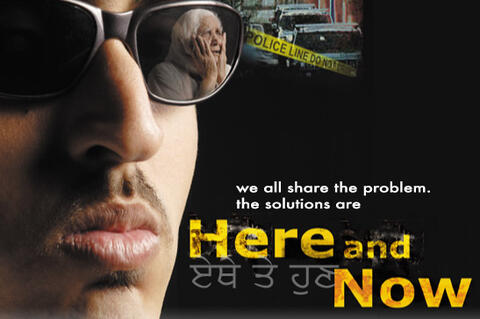
Here and Now explored the connections between gang violence and home-life using a communication-based methodology called Forum (audience-interactive) Theatre. Practiced in various ways all over the world, Forum Theatre centres around a play that builds to a crisis and stops. It is shown once in its entirety, without interruption. The play is then shown a second time in order to enable audience members to yell "STOP!" if they recognise the struggle a character is having within the story and if they have an idea how to create safety or solve the problem in the world of the play. The audience member comes out of his or her seat, up onto the stage, replaces that character, and tries out their idea. This is called an "intervention". This highly participatory art form is based on the premise that "a living community has both the responsibility and the ability to deal with issues in the community. While the theatre expertise may be coming from outside the community, the knowledge that the theatre process unlocks resides in the community itself."
The Here and Now public "intervention" emerged from such a process - one involving community collaboration at its centre. Headlines Theatre staff began the process by meeting with community leaders to explore how to involve diverse groups of community members in the theatre-based project. In October 2005, organisers gathered a group of approximately 20 local participants in an effort to provide (paid) opportunities for creative, community-based dialogue. In recruiting participants, organisers worked to reach out to those who are living the issues under investigation. They focused at a very grassroots level by accessing women's and support groups, English as a second language (ESL) programmes, sectors of the community affected by violence, small neighbourhood gatherings, and the like - always in close collaboration with Indo-Canadian workers. Those who were selected engaged in games and exercises that were designed to help them investigate issues such as: Does the issue of street violence connect to the issues of violence in the family, schools, clubs, etc.? If it does, how? How is it that people get involved with violence? Why and how are issues of identity central, and how does gender play into the assertion of one's individuality, on the one hand, and membership in a group, on the other? Using the workshop as the material from which the performance grew, the cast, production team, and director created an artistic production for presentation to the public.
The play itself was performed in community spaces in Vancouver and in Surrey; the strategy involved bringing the production to where the community lives rather than asking audiences to travel to a central theatre location. A community member knowledgeable in the social services area was hired to attend these performances as a "Community Scribe". This person's reflections were then collated and analysed in terms of the kinds of initiatives that could evolve in the community. The resulting Community Action Report was made available to social service agencies and other interested parties. In addition, a community television broadcast and a video/DVD emerged from the process for use by community agencies, once the live production ended.
Other types of information and communication technology (ICT) were used to bring "Here and Now" to a global audience. A live, interactive webcast of the production took place on December 11 2005. The idea is that viewers around the world could log on, watch the play, suggest an intervention, and see their idea(s) come into action - through an actor, live on stage in Canada.
Conflict.
Organisers observe that immigrant communities face specific challenges in Canada, such as a new language, climate, and a culture with very different values. "These challenges sometimes lead to marginalization of both individuals and groups, to community frustration, and to both internalized and externalized violence."
In light of these issues, beginning in September 2004 the Vancouver Sun ran a 6-part series of articles that focused, in large part, on violence in the Indo-Canadian community. As a result, Headlines Theatre staff requested a meeting with various leaders in the community who are dealing with the violence issue. "What we have understood is this: The newspaper articles do not, and probably, cannot, tell the whole story....While the news media focuses on 'high profile' crime, very little is discussed about the roots of such crime and violence and its specific impact on community life as it is lived from day to day."
Email from International Theatre of the Oppressed (ITO) to The Communication Initiative on December 5 2005; and Here and Now page on the Headlines Theatre website.
- Log in to post comments