










































Citizens Radio: Spaces for Democracy (Radios Ciudadanas: Espacios para la Democracia)
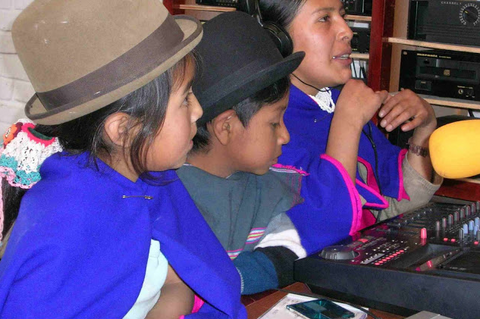
This national project, created by the Ministry of Culture of Colombia's Radio Unit since 2004, seeks to generate dialogue, discussion and deliberation around issues of public interest in the municipalities and departments (equivalent to provinces or states) of Colombia. Through the production of a radio slot based on a common set of content and conceptual guidelines that are broadcast daily and simultaneously throughout all regions, dialogue is facilitated contributing to transforming local governance issues and improving citizens everyday realities.
After identifying themes of interest which are relevant to each and every community, the programme addresses key issues related to the recognition of cultural diversity, human development, governance, and peaceful coexistence. The objective is to strengthen and consolidate the notion of public spheres, where different interests and needs inherent to plurality are recognised and respected, based on a rights-based approach.
Citizens Radio: Spaces for Democracy is a programme of the Ministry of Culture, co-sponsored by USAID/Colombia (through the ADAM, IOM, FUPAD, CIMIENTOS programs), and by the Presidential Agency for Social Action and International Cooperation. It also has the support of Mayors and Governors' Offices in the country.
The radio programmes are produced at the local level by municipal radio production teams, with the support of rural reporters, youth associations, and university students, and are broadcast from Mondays to Fridays in a public opinion slot, in each of the 45 community radio channels involved in the project.
The intervention includes the following elements:
- Production: It promotes the creation of public opinion slots for the community and the community radios' programming, which contribute to reflection, analysis and civic education. These slots are composed of magazine programmes produced by a combination of a national level team (the Ministry of Culture in association with partner organisations) and a local level team (communication "collectives" and/or CSO groups). They both analyse - from their different perspectives - the same subject matter and explore different ways of narrating and storytelling around these issues through the radio.
- Participation: It encourages the participation in the community radios of diverse social actors and social groups (youth, peasants, women, indigenous people, Afro-Colombians, displaced communities, etc). This participation is effectively promoted through the local councils, the Radios Ciudadanas programming committees, youth groups , schools' communication "collectives" and the rural reporters promoted by the project.
- Training: it promotes capacity building processes on key issues which include: citizenship, radio production, management and sustainability of community media. The target audience includes radio producers, cultural managers/advocates, community leaders and citizens linked to the Radio Ciudadanas Program. The main strategy of this component is the ongoing Training School of Citizens' Radio (Escuela Permanente de Formación de Radios Ciudadanas).
- Advocacy: this promotes the organisation and institutional strengthening of community radio stations and the positioning of these media actors in the cultural sector and within local and departmental development plans.
Each programme is framed within a strategy that includes the following elements:
- Monitoring: The programme monitors, accompanies, and guides the regional operators, practitioners, the local communication collectives (groups), and the radio channels, in the implementation and development of each programme component.
- Systematisation and evaluation: The programme collects, systematises and analyses information provided by the programme, with the objective of identifying the dynamics and lessons learned during its implementation. It also identifies the results and their impact on the community channels, the audiences, and the local and regional public institutions.
- Management and Sustainability: It promotes the strengthening of community radio stations and the management of strategic partnerships at the national, regional, and local level, seeking to ensure the sustainability of the processes initiated by the programme.
- Communication: it networks and connects the various actors involved in the programme whilst it aims to position it in different contexts.
Democracy and Governance, community radio
The Citizens Radio have reached an important level of recognition based on a number of strengths:
- They are means to inform, sensitise and educate communities.
- They offer different sectors, groups and individuals the opportunity to express their views, interests, concerns, needs and proposals.
- They allow the participation of communities in local socioeconomic and cultural processes.
- They provide spaces for analysis, dialogue and debate to reach consensus on public affairs.
- They strengthen the recognition of cultural diversity and the positioning of local identities.
- They constitute channels for accountability processes and citizens' social control.
- In some of the most remote municipalities of the country, Citizen´s Radio are the only means of communication.
Website of the Ministerio de Cultura de Colombia (Ministry of Culture) and the Radio Unit of the Direction of Communication.
- Log in to post comments