










































Pahunch Reality TV Game Show: A Reality TV Show to Strengthen Relations between the Police and the Public
"Reality shows have great potential for peacekeeping as they spark dialogues around issues that are barely discussed in the public sphere..." - Yubakar Raj Rajkarnikar, Producer of Pahunch reality TV game show
Pahunch (ACCESS) is a reality TV game show produced by Search For Common Ground (SFCG) - Nepal with the intent to foster a sense of empathy for and trust in the police in Nepal. The entertainment-education initiative, which involves participation of everyday Nepalese, reiterates the importance of collaboration between the Nepal Police and the citizenry in order to uphold peace and security.
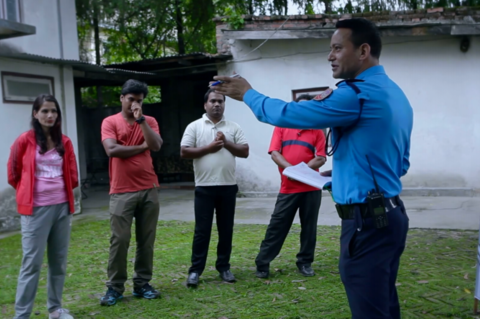
Beginning on September 23 2016, the show is broadcast every Friday at 7:25pm on Nepal Television. Pahunch has been planned for 3 seasons, each one composed of 13 episodes. The reality show features 8 contestants hailing from diverse social and political backgrounds, such as Sophie Sunuwar, who is a makeup artist and an lesbian, gay, bisexual, transgender, and intersex (LGBTI) activist, Maya Syangten, a national basketball player, and Gyan Bahadur Lama, a former Maoist. With the mentorship of Nepali police officers, participants solve fictional cases of homicide, burglary, domestic violence, human trafficking, sexual harassment in public transport, and more. By having citizens of diverse backgrounds and police personnel work together, the purpose is to raise awareness of the challenges faced by the security forces and establish a sense of trust between police and communities. To give the show a realistic touch, the producers, working in close coordination with the Nepal Police, create clues, settings, and a plausible background story for all the tasks based on the real-life scenarios the security personnel experience. Citing an example during the filming, Pahunch director Tsering Rhitar Sherpa explained, "The contestants were given the task to perform the role of traffic police. As they did their tasks, they realised how difficult it was for the traffic police to work despite the heat and dust, amidst the dangers lurking on the roads. It came through their dialogues and discussions." Facilitated dialogue screenings were conducted in different parts of the country.
The Inspector General of Police (IGP), Upendra Kanta Aryal, expressed that media plays an instrumental role in peacebuilding and is effective in addressing differences. He stated, "We are hopeful that the reality TV game show will help foster a sense of belonging of the public towards the police. 'PAHUNCH' is designed to increase public access to justice and security, and it also echoes a powerful message that the Nepal Police cannot function effectively without public support.
Having solved a real-life case, contestant Gyan Bahadur Lama, a former Maoist combatant, was declared the winner of the reality show. He was awarded a cash purse of Rs 200,000. After winning, he stated, "I am grateful to my fans who supported me throughout this journey. I am thankful to the Nepal Police officers who trained and mentored us." He also expressed his commitment to working closely with the Nepal Police. "During the conflict, I thought the police were against us. But, after being a part of Pahunch, I have realised that they too are like us, and they need our support," Lama added.
The show is part of a wider 4-year effort, funded by the United Kingdom (UK) Department for International Development (DFID), to reform the security sector and improve the access to justice mechanisms for marginalised communities in Nepal. In consortium with the Centre for Legal Research Resource Development, the Human Rights and Community Development Academy Nepal, and the Centre for Security and Justice Studies, SFCG Nepal is working to raise public awareness on security and justice, increase public-police partnerships and accountability, foster community mediation skills, and improve service delivery of the local police, local courts, and legal aid. For example, SFCG Nepal has created downloadable stickers featuring traditional Nepali art with the request that people share them on social media with the hashtag #PAHUNCH! They have also organised a Dohori (a popular musical performance similar to a singing debate), soccer tournaments, and a repainting of police station walls using traditional Mithila painting as a way to bridge the two communities. Click here to read more about the creative ways Pahunch is using to approach the public and present the police in a positive manner.
Justice, Security, Democracy and Governance, Women, Youth
Yubakar Raj Rajkarnikar, Director of Programmes of SFCG Nepal, said: "The public recognizes the police as a symbol of 'authority', but they are not aware of the challenges that the police have to overcome in order to establish peace and security. The reality game show is crafted to evoke empathy, responsibility, and collaboration between the public and the police."He continued: "The reality show has succeeded in humanising the police, and also triggering a sense of belonging among public and police. Nepal Police cannot function in isolation, and they need the support of the public to ensure peace and security - this is the key message of the reality TV game show."
One of the contestants, Sophie Sunuwar, stated, "Before, I used to fear the police. I had this misconception in my head that they were bad. But after interacting with the police, I realized that I was wrong. The police too are like us, and need our support to uphold peace and security in the community." According to SFCG, the reality TV show has heralded a positive discussion on police and public partnership and sparked a sense of empathy in the public towards the police and their work.
Pahunch is funded by UKAID, supported by Nepal Police, and produced by SFCG, along with production partner Mila Productions.
Pahunch website; Pahunch on Facebook; and SFCG Nepal website - all accessed on October 26 2016; and emails from Ayush Joshi to The Communication Initiative on October 27 2016 and February 26 2017.
- Log in to post comments