










































Tech Age Girls (TAG)
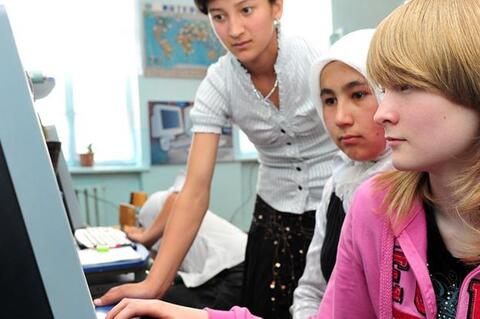
"[E]fforts to improve girls' potential must go beyond training and start creating an ecosystem in which skills can be maximized. This means addressing leadership and self-confidence, creating support networks, developing allies and advocates, and instilling an understanding of how to assess needs and conceive ways to address them in communities and in the business world." - Myahriban Karyagdyyeva (Mehri) and Ari Katz, IREX
IREX's Tech Age Girls (TAG) programme provides young women with specialised leadership and information technology (IT) training, mentors, and hands-on opportunities to become positive agents of change in their communities. Broadly, TAG addresses the systemic underrepresentation of women in the IT field and promotes the online presence of girls’ voices in local languages. Launched in 2005, TAG has been implemented in Azerbaijan, Kyrgyzstan, Moldova, Myanmar, the Philippines, Turkmenistan, Ukraine, Uzbekistan, and Vietnam.
TAG works to empower girls within a community of support. Participants are self-selected throughout different stages of the project based on their participation, completion of projects, and level of activity. The most dedicated participants are identified through this process and graduate to the final stage of the programme. TAG connects girls to women role models, places them in internships, and plugs them into an alumni network and community. Technology is not taught for the sake of technology, but rather used as a tool for empowering girls, building their self-esteem, giving them confidence, and building connections through alumni networking.
TAG participants attend events that enable them to discover new abilities, develop technical and professional skills, and gain the confidence and inspiration necessary to become leaders in their communities. Participants cover a curriculum of digital and leadership skills development, ranging from graphic design and communication skills to problem solving. TAG's curriculum does not involve traditional lectures or tests. Instead, participants work in collaborative small groups on different tasks that use technology to create useful products. Supported by a network of peers, they apply the skills they have learned in outreach to their communities. Participants have led digital skills training for community members and local teachers and formed groups to raise awareness about gender issues and the benefit of access to digital skills.
Specifically, the TAG model has 3 phases that take place over 1 year:
- Phase One lasts up to 6 months, during which time participants receive training to strengthen their leadership, information and communication technology (ICT), and "soft skills" while forming an in-person and online community. For example, they explore positive communication, active listening, principles of storytelling, and how to write success stories with good pictures/reports, including group work on stories. They research pressing community needs, then design and conduct service projects to meet those needs with support from TAG staff and local mentors.
- Phase Two focuses on how the technology tools learned in Phase One can be applied to community service and leadership as well as to improve individual economic and employment opportunities. It brings the highest achievers to a one- to two-week in-person workshop in a major city, where girls participate in advanced technology and leadership training (e.g., they learn to create a storyboard from start to finish and create a shareable story using Comphone), perform short internships at domestic and international non-governmental organisations (NGOs) or government offices, and meet influential, national-level women leaders. Additional activities in this phase include: interactive panels and debates with women role models in a variety of fields, including civil society, politics, and entrepreneurship; guest speakers who introduce girls to new ideas and opportunities for applying their skills; project presentations designed to give girls the opportunity to practice their public speaking skills in front of peers and mentors; excursions that expose girls to parts of their country they may have never before experienced and that provide the girls the opportunity to strengthen their peer networks; and an award ceremony to highlight and celebrate the achievements of the participants.
- Phase Three begins when participants return to their communities to continue or expand local projects such as training their peers in key technology and soft skills, remaining linked to the TAG network of young women leaders. Each community project is designed and adapted to the local context, and responds directly to community needs identified by TAG participants. Each project reaches an average of 30 people and touches on many aspects of community life, including public service, environment, and education. For example, 35 students were taught in an informal learning programme led by a TAG participant in a village in Magway, Myanmar. To make her project more effective, she advocated for solar panels for lighting, writing materials, and technology to enhance learning. In Kyrgyzstan, a group of 5 Tech Age Girls trained political party representatives on new communication tools: "I am only 16 years old, but I was able to work with politicians in our country....[After] working with female politicians, I know that politics is not only for men...," noted one of the trainers, who had been a TAG participant in 2011. Tran Le Khanh Linh, a 2012 TAG from Vietnam, organised trainings on leadership and basic IT skills for 60 of her classmates, while her fellow TAG peer Trinh Hoai Huong trained members of the journalism club at her school on creating digital stories.
Girls, Information and Communication Technology (ICT)
According to Intel [PDF], 23% fewer women than men are online in the developing world, and 40% of women who don't use the internet blame lack of familiarity or comfort with technology.
According to IREX, economic development and women's empowerment are closely related goals. Eurasian countries seeking to maximise their economic potential have a distinct interest in making the most use of all their human capital, male and female. By promoting greater female representation in the professional field of IT and in the realm of public debate, TAG aims to support the economic and political development of Eurasia at the individual and community levels.
By 2015, IREX had trained over 1,300 girls in digital and leadership skills. Participants then implemented 400+ service projects that reached more than 10,000 people. When TAG alumnae were surveyed 5-10 years after participating, 80% of respondents reported that the digital skills they learned through TAG made them more competitive in the job market, 76% maintain the support network they gained, and 83% were still active in their communities.
Support from the Bill & Melinda Gates Foundation, Organization for Security and Co-operation in Europe (OSCE), Peace Corps, the United States Agency for International Development (USAID), and the US Department of State.
Tech Age Girls Myanmar [PDF], Tech Age Girls Curriculum Overview [PDF] - from Beyond Access - and TAG page on the IREX website; "Who are the Tech Age Girls?, by Myahriban Karyagdyyeva and Ari Katz, IREX, on the UNESCO website, March 18 2014; and TAG on Facebook - all accessed on June 7 2017; and email from Sylvia Cadena to Liane Cerminara on November 20 2017 (sent to The Communication Initiative on November 21 2017).
- Log in to post comments