










































Inner Spaces Outer Faces Initiative (ISOFI)
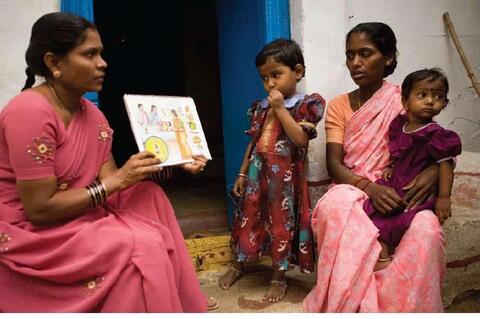
Developed by the non-governmental organisation (NGO) CARE, this maternal and newborn health (MNH) behaviour change communication (BCC) initiative was designed to address basic underlying causes of poor health in Uttar Pradesh, India - namely, discrimination on the part of health care workers based on clients' gender and sexuality.
ISOFI used a variety of methods to communicate the following: Every person has both an "internal space" and an "outer face". Their internal space includes their perceptions of issues such as gender, sexuality, family, and identity. Their outer face represents the way they communicate ideas with others. Although these two concepts are very connected and can be mutually reinforcing, they can also conflict. For example, a public health professional working with unmarried adolescents may believe that providing sexual and reproductive health information and services for unmarried people is not proper, based on his or her culture, even though that professional is working to serve the needs of an entire community, including unmarried people.
In this context, the first phase of ISOFI (2004-2006) explored ways to build staff and organisational capacity to identify and address gender and sexuality inequities; the second phase of ISOFI (2007-2010) aimed to improve the capacity of both staff and community members to address social as well as medical issues related to MNH, and to measure the effectiveness of both. The second phase began with two training workshops (January and June 2008) to all project and partner staff in the district. The workshops were designed to ensure that participants would have some exposure to a variety of opinions and values related to gender and sexuality issues and be able to speak about them sensitively in professional settings. Facilitators for the trainings were chosen from a local sexuality rights NGO with strong ties to groups that advocated for the rights of socially marginalised groups (lesbian, gay, bisexual, and transgender people (LGBT), sex workers, etc.). This was an effort to help ensure that the workshops used local language and presented material in a locally appropriate context, as well as to strengthen links between the project and local NGOs. The workshops were designed to be participatory. Although some theoretical presentations were made, most workshop time was devoted to exercises, films, and group discussions.
Then, the second phase went on to use up to 4 levels of intervention, depending on where it was implemented: (1) district- and sub-district-level advocacy for commitment to MNH activities; (2) community-level interventions through training of government-paid health outreach workers to support established village health and sanitation committees and to establish new mothers' committees focused on behaviour change; (3) household-level counselling and support for pregnancy, delivery and the postpartum period; and (4) a more intensive household-level intervention focused on household services and commodities. Key health behaviours targeted by the project included: birth preparedness, recognition of danger signs in pregnancy, immediate and exclusive breastfeeding, clean cord-cutting practices, and thermal care for newborns.
CARE used these platforms for MNH behaviour-change interventions as opportunities for exploring values and challenging assumptions about gender and sexuality norms. The organisation integrated iterative and open-ended exercises for discussion on gender and sexuality with ongoing project interventions at all levels. In some sub-districts, CARE also organised men's group meetings in remote villages and created new platforms for public dialogue that promoted discussion and debate about social norms. ISOFI also introduced larger social events open to the general public, such as puppet shows, magic shows, street plays, and film screenings - each with a facilitator to prompt public discussion about gender values and norms in the community.
Women, Children, Gender, Health, Reproductive Health.
CARE's experiences in working in the area of MNH have confirmed that "improving quality of health services is not enough, nor is improving demand for health services or even teaching people about health behaviours. Reducing social barriers can, in fact, help improve the health of the community. Moreover, we have learned that addressing certain cultural norms related to gender and sexuality, such as early marriage, women's limited mobility, or household violence can also significantly influence health outcomes. Through close collaboration with communities, we now are able to carefully design and incrementally implement projects that holistically address social determinants of poor health, with each project tailored to the needs and resources of the community where it is implemented."
Comments

Communications
Through this post we have learned that addressing certain cultural norms related to gender and sexuality, such as early marriage, women's limited mobility, or household violence can also significantly influence health outcomes.This is sometimes our baseline on how to implement actions towards future concerns that may arise in the environment.
Eunice
- Log in to post comments