










































An Artificial Intelligence Chatbot for Young People's Sexual and Reproductive Health in India (SnehAI): Instrumental Case Study
The State University of New York (Wang, Gupta); The University of Texas at El Paso (Singhal); Inland University of Applied Sciences (Singhal); Population Foundation of India (Muttreja, Singh); AI for Good UK (Sharma, Piterova)
"Understanding both positive and negative aspects of the affordances of AI chatbots such as SnehAI can help inform future endeavors to reinforce and amplify the positives and minimize the negatives when designing, implementing, and studying these technologies."
SnehAI is a Hinglish (Hindi + English) artificial intelligence (AI) chatbot co-created with and for young people, especially those from vulnerable groups, to fill a communication gap around sexual and reproductive health (SRH) topics in India. SnehAI uses the entertainment-education (edutainment) strategy to foster social and behavioural change. Specifically, it aims to provide a private, nonjudgmental, safe space to spur conversations about taboo topics (such as safe sex and family planning) and to offer accurate, relatable, and trustworthy information and resources. This study focuses on the different ways SnehAI enables SRH information sharing and user engagement, offering guidance on how AI chatbots can be used to educate adolescents and young adults, promote SRH, and advocate for the health entitlements of women and girls in India.
First, the researchers present the guiding framework for the case study: the Gibson theory of affordances. In stressing that our behaviours are shaped by our environment, this theory has influenced the design of everyday objects and user experiences of human-computer interaction. "Affordances" have been used as a high-level theoretical framework to understand the internet, mobile and social media, and digital apps for eHealth. As SnehAI is accessible through the Facebook Messenger mobile app, the literature review provided here focuses on discussions regarding the affordances of relevant technologies, especially those pertaining to health promotion and education, to set the conceptual foundation for the analysis.
Next, the paper lays out the study context and detail the development of SnehAI. Although its current version is a standalone AI chatbot, its original idea and predecessor were rooted in the Population Foundation of India's initiative Main Kuch Bhi Kar Sakti Hoon (I, a Woman, Can Achieve Anything). This initiative, which is described at Related Summaries, below, consisted in a transmedia edutainment social and behaviour change communication (SBCC) strategy, coordinated across multiple media platforms (e.g., television, radio, social media) to challenge deeply entrenched regressive gender norms and to advocate for women's empowerment. SnehAI was created in partnership with the technology organisation AI for Good in April 2019, during season 3 of Main Kuch Bhi Kar Sakti Hoon, to extend the character Dr. Sneha's media personality as a trusted friend. Co-created with 84 adolescents and 19 adults to ensure a friendly tone of voice with familiar colloquial expressions, SnehAI was promoted through Main Kuch Bhi Kar Sakti Hoon's website, interactive voice response (IVR) system, Facebook page, and other channels.
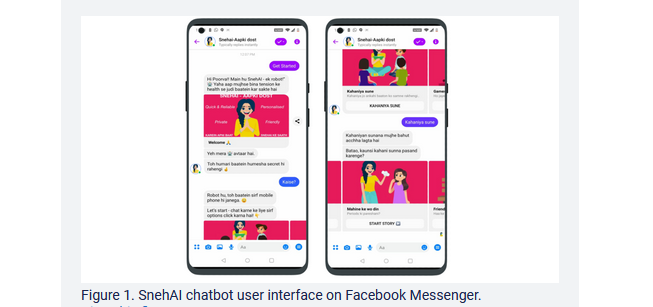
This paper focuses on version 2.0 of the AI chatbot, which was launched in April 2020 with a natural language processing (NLP) platform and better content flow to make Dr. Sneha, the avatar, more intelligent in her conversations with users. The paper describes how the tool works, including its five content categories: (i) Mere baare mein (About me); (ii) Videos dekhein (Watch videos); (iii) Kahaniyan sune (Listen to stories); (iv) Games khelein (Play games or take a quiz); and (v) Helplines - one providing information and counseling on SRH, and one offering counseling and reporting on gender-based violence.
The case study is informed by qualitative insights were obtained from key stakeholders via 2 in-person group meetings, 4 virtual conferences, and numerous email discussions from September 2018 to December 2020. Various reports and meeting notes served as foundational documents for the analysis. Quantitative data were obtained through unobtrusive chatbot user behaviour tracking with user permission. The data science team at AI for Good also randomly selected 15,000 free-text messages with over 20 characters and used machine learning techniques to detect user behaviour patterns.
The results of the instrumental case study "provide evidence that SnehAI offers a safe space for users to talk about sensitive SRH topics, seek and obtain accurate information, access services locally through helplines, and seek personal counseling". Specifically, seen through the lens of Gibson's theory, the researchers distil 15 functional affordances of SnehAI:
- Accessibility: SnehAI provides "a digital platform for Indian youth to access highly accurate and credible information about SRH in a safe, nonjudgmental space."
- Multimodality: SnehAI uses "popular media modalities such as videos, GIFs, and emojis to enhance engagement."
- Nonlinearity: SnehAI offers curated content in branched categories that allow users "to take control of their experience as more of a choose-your-own-adventure type of journey."
- Compellability: SnehAI compels users "to open up through her [Dr. Sneha's] relatable and approachable avatar image and tone."
- Queriosity: SnehAI welcomes queries and encourages user curiosity about SRH topics.
- Editability: SnehAI enables users to reword, redraft, and rescript how they present themselves in the digital space.
- Visibility: SnehAI allows users to privately and securely save their chat history, making it visible at any point.
- Interactivity: SnehAI simulates "conversational turn-taking and immediate verbal and nonverbal feedback."
- Customisability: SnehAI enables users to "navigate the curated content according to their interests", using its "machine learning capability to customize responses."
- Trackability: SnehAI tracks users' web-based behaviours through clickable actions and self-generated content.
- Scalability: SnehAI has the potential to be scaled up through various adolescent health education programmes, networks of frontline health workers, and service providers.
- Glocalisability: SnehAI enables linkages between young people and service providers in their local areas.
- Inclusivity: SnehAI is a free digital consultation repository, which can reach users with diverse backgrounds, especially underserved population groups such as women, youth, and rural residents.
- Connectivity: SnehAI creates "the conditions for users to connect parasocially with a respected and trustworthy avatar at a deeply personal level."
- Actionability: SnehAI uses "the power of transmedia storytelling to inspire users to take concrete actions to seek help for themselves and their peers."
Data indicate that, over a 5-month period (May-September 2020), nearly 8.2 million messages were exchanged between SnehAI and 135,263 unique chatbot users, including 5,100,449 (62.42%) outgoing messages from the chatbot to the users and 3,070,430 (37.58%) incoming messages from the users to the chatbot. User engagement was also tracked through the content categories, including both guided flows using clickable reactions and the handling of free-text messages using NLP; these data are shared in the paper. Notably, gender-disaggregated data indicate an extreme gender gap: Among the unique chatbot users over this 5-month period, 93% (125,795/135,263) were male, 6.8% (9,198/135,263) were female, and 0.2% (270/135,263) were unknown. Furthermore, based on 15,000 sampled queries, the data science team found "a behavioral pattern with female users showing significantly lower self-confidence in their conversations with SnehAI." This finding might be a function of female users facing gender disparities in mobile device ownership and low digital media literacy in India. There were also incidents where male users requested SnehAI to set up a girl for them, and some even engaged in obscene chats, expressed intimacy through sexting, asked for porn videos, and used abusive language.
In response to these findings, the team is working to adapt field-based promotional strategies to include more female users. Other opportunities for improvement based on the results include the following:
- A more intelligent NLP model coupled with targeted behaviour change strategies focusing on awareness building and empowerment of women and girls to reduce gender bias.
- Reminders and nudges to re-engage idling and inactive users.
- An option to edit or recall a text message after sending it out to the chatbot or to use voice-based input and output to include users with low literacy.
- A possibility to customise the menus, filter contents, and search information in the chatbot when the digital artifacts propagate to a larger scale.
- A feature that allows the user to invite other trusted friends to use the chatbot and leverage anonymous and aggregated user data to boost user participation and peer-to-peer learning.
- A mechanism to educate the most vulnerable users on how to protect their privacy, safely participate in web-based activities, and advocate for their basic human rights.
- A network that can directly connect the chatbot users to their local health and social services - for instance, enabling helpline dialing and scheduling appointments through the chatbot.
The paper closes with a deeper discussion of major findings, implications for theory and practice, and directions for future endeavours. In conclusion: "The comprehensive checklist of affordances and critical user engagement analytics from this case study are not only a powerful testimonial of SnehAI itself but also a significant representation of the potential and impact of AI technologies on social good."
Journal of Medical Internet Research 2022;24(1):e29969 - sourced from email from Hua (Helen) Wang to The Communication Initiative on January 20 2022.
- Log in to post comments