










































Biruh Tesfa (Bright Future) Project
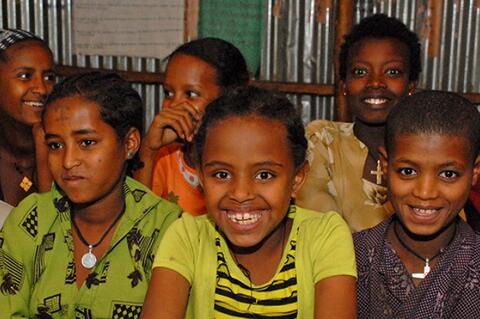
Trained female mentors recruit girls by going house-to-house, identifying eligible out-of-school girls aged 10–19. According to the organisers, the house-to-house visits allow mentors to contact girls who may otherwise be missed, such as child domestic workers who are largely confined to the home. In addition, contact at the household level allows mentors to negotiate for girls' participation with gatekeepers such as employers of domestic servants. Mentors often emphasise the non-formal education component of the programme, finding that employers and guardians are generally supportive of educational opportunities for girls.
Once in groups, the programme promotes functional literacy, life skills, livelihoods skills, and HIV/reproductive health education through girls' clubs led by adult female mentors. Programme services ensure that: girls have access to health care; rape survivors can obtain support services; and a shelter is available for evicted domestic workers (many of whom are migrant girls). Girls also receive identification cards and some receive vocational training and job placement.
Girls' clubs are held in meeting spaces donated by the kebele (local administration). These meeting spaces are simple social halls in the community, equipped with benches and blackboards. Organisers point out that meeting spaces remain a challenge. In slum areas, space is at a premium and several clubs are forced to meet in one room, with some meeting facilities lacking running water or proper toilets. Groups generally meet for two hours, three to five times a week. Girls whose time is limited due to work or control by employers attend less regularly and meeting times are varied to accommodate the various schedules of working girls. Some groups meet in the morning hours, some in the afternoon, and some in the early evening, a session which is dominated by domestic workers.
Gender, Girls, Education.
According to the Population Council, over 17,000 out-of-school girls have participated in Biruh Tesfa groups in five cities in Ethiopia, including the capital, Addis Ababa. Overall, one-third of participants are in the younger age group, 10–14 years, and in Addis Ababa, nearly half (49%) are younger adolescents. Biruh Tesfa girls are from very disadvantaged backgrounds: 44% have lost at least one parent and 16% have lost both parents. Although many girls do not know the reason for their parents' deaths, it is more than likely that many have lost their parents to AIDS. Less than one-third of participants are living with their parents. Many are living with extended family members or non-relatives. According to the organisers, the project is the first of its kind designed for child domestic workers - one-third of Biruh Tesfa beneficiaries are engaged in child domestic work. Organisers have recently expanded Biruh Tesfa to 12 more cities in Ethiopia.
Ethiopian Ministry of Youth and Sport, Addis Ababa Bureau of Youth and Sport, Amhara Regional Bureau of Youth and Sport, Kebele Administrations of Addis Ababa, Bahir Dar, Debre Markos, Dessie, and Gondar, The Population Council, Ethiopian Women with Disabilities National Association, Nia Foundation, Organization for the Prevention, Rehabilitation and Integration of Female Street Children, Young Women’s Christian Association.
Donors: the United Kingdom'd Department for International Development (DFID), Nike Foundation, President's Emergency Plan for AIDS Relief (PEPFAR), The Turner Foundation, United Nations Foundation, United Nations Population Fund, United States Agency for International Development (USAID), Fisher Family Foundation, and individual donors.
Population Council website and Biruh Tesfa Programme Brief 2010 (PDF) on March 17 2010.
Photo Credit: Annabel Erulkar
- Log in to post comments