










































Caravan of Hope
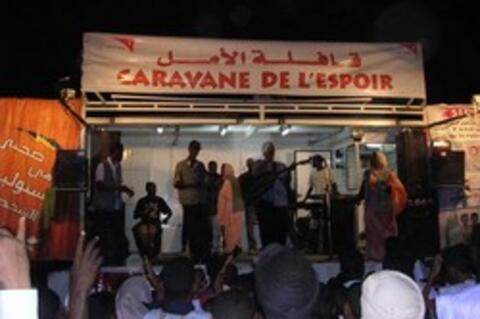
The Caravan of Hope team aims to communicate life-saving lessons about issues such as child health, malaria prevention, and HIV/AIDS awareness through entertainment-education. The mobile theatre travels in a truck equipped with a sound system and a giant screen. It serves as the vessel for a show featuring music, locally produced short fiction movies, and sketches by entertainers from SOS Peer Educators of Nouakchott. These entertainers, who usually number 25 on board the truck, speak local languages in order to reach a wider audience. Every night there is a performance that addresses different issues related to HIV/AIDS, such as abstinence, fidelity, responsibility, and condom use. During the day, a car equipped with a loud speaker cruises the streets to announce the evening show. By evening, a crowd gathers to watch the event, sitting on the ground or standing and clapping their hands.
After every show, the project organisers assess the public's reaction to find out what interests them. "Priorities and interests are different depending on populations. Adaptation is essential to get the message through." At times, they might invite a doctor up on stage to reinforce the message, or ask an authority such as the Hakem (county administrative leader) or the mayor to play host to give the evening more weight.
The organisers have chosen not to distribute condoms due to conservative social pressures. However, they are trying to set up a network of local peer educators in every town to support their activities.
HIV/AIDS, Health.
Three new short movies have been produced, and 200,000 basic information folders were produced in order to be distributed to the public during the 2005 tour.
In Tiguent - as well as in other river valley towns such as Mbagne, Rosso, Bogué and Kaedi - the show has attracted big crowds of up to 7,000 spectators an evening. "Our dream has come true," said Jon Shadid, co-founder of the initiative. "We never thought AIDS and sexually transmitted diseases would keep people listening for four hours at a time."
World Vision, Nedwa, national secretariat of the fight against AIDS (SENLS), United Nations Children's Fund (UNICEF).
Irin News website on June 9 2005 and February 10 2009.
- Log in to post comments