










































Creating COVID-19 Stigma by Referencing the Novel Coronavirus as the "Chinese Virus" on Twitter: Quantitative Analysis of Social Media Data
University of Alabama at Birmingham
"...COVID-19 stigma is likely being perpetuated on Twitter."
Stigma is a structural force that devalues those who are thought to have undesirable characteristics. Among its effects is internalisation, meaning that people can become distrustful of health professionals and systems and reluctant to disclose behaviours related to disease transmission. In the context of the coronavirus disease (COVID-19) pandemic, the worry is that creating and perpetuating stigma related to COVID-19 could be detrimental to public health efforts that require potentially stigmatised individuals to engage with their health systems (e.g., through contact tracing and testing). This study examined whether there was an increase in the prevalence and frequency of the phrases "Chinese virus" and "China virus" on Twitter after the United States (US) presidential tweet referencing this term.
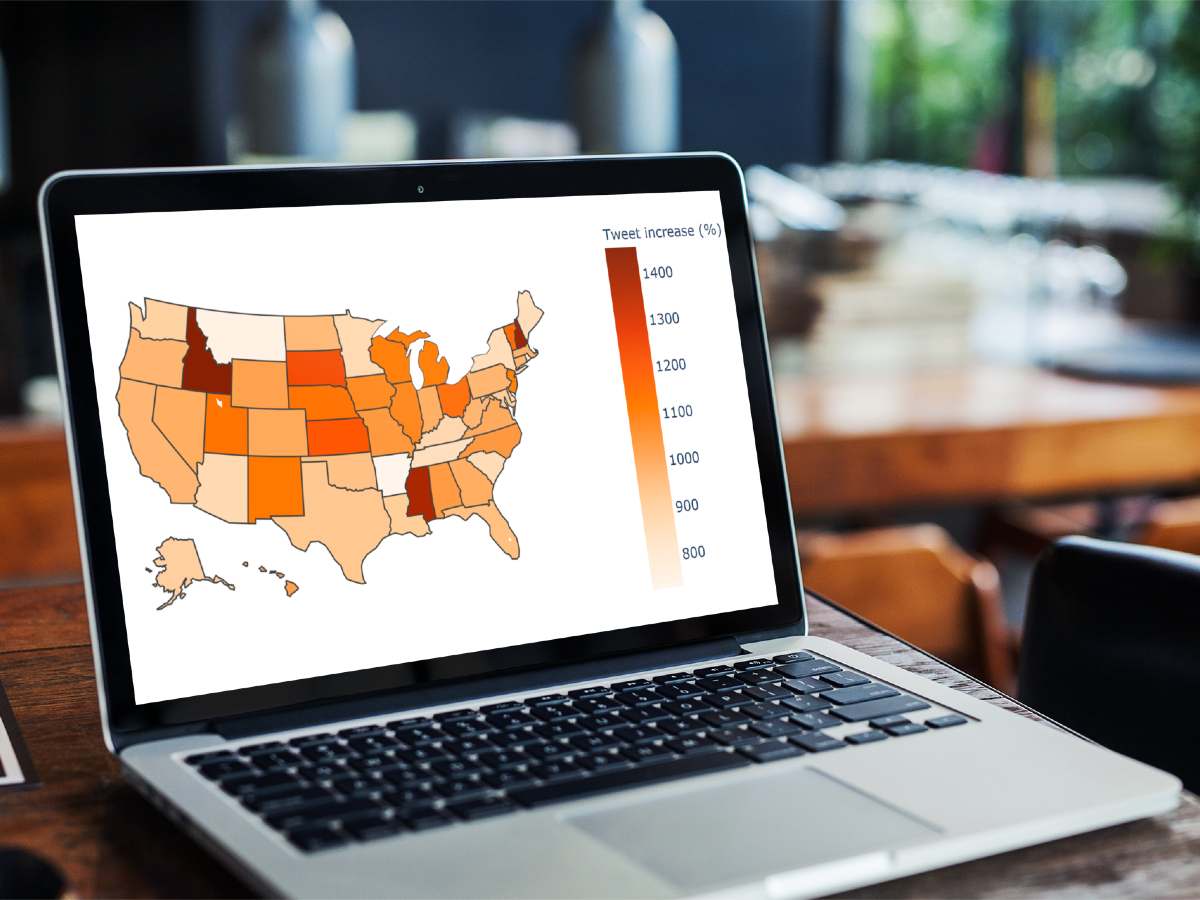
On March 16 2020, the US president referred to the novel coronavirus as the "Chinese virus" on Twitter, sparking a dialogue about whether this phrase was xenophobic and stigmatising, considering the availability of alternative scientific names, such as coronavirus or COVID-19. In an effort to contribute to the debate, the researchers extracted tweets from the US using a list of keywords that were derivatives of "Chinese virus". We compared tweets at the national and state levels posted between March 9 and March 15 (preperiod: prior to the tweet in question) with those posted between March 19 and March 25 (postperiod). They used Stata 16 (StataCorp) for quantitative analysis and Python (Python Software Foundation) to plot a state-level heat map.
In total, 16,535 "Chinese virus" or "China virus" tweets were identified in the preperiod, and 177,327 tweets were identified in the postperiod, illustrating a nearly 10-fold increase at the national level. The following are examples of these tweets: "Not parroting MSM's [main stream media's] narrative. It's the #WuFlu #ChineseCoronaVirus #ChinaVirus" and "#ChinaVirus #ChinaLiesPeopleDie". All 50 states witnessed an increase in the number of tweets exclusively mentioning those 2 phrases instead of "COVID-19" or "coronavirus". On average, 0.38 tweets referencing "Chinese virus" or "China virus" were posted per 10,000 people at the state level in the preperiod, and 4.08 of these stigmatising tweets were posted in the postperiod, also indicating a 10-fold increase. The 5 states with the largest increase in pre- to postperiod "Chinese virus" tweets were Kansas (1,202% increase), South Dakota (1,233% increase), Mississippi (1,387% increase), New Hampshire (1,420% increase), and Idaho (1,457%).
In discussing related studies conducted in prior pandemics, the researchers cite the work of Chew and Eysenbach, who conducted an examination of knowledge translation using Twitter data during the H1N1 outbreak; they found the proportion of tweets using "H1N1" increased over time compared to the relative use of "swine flu", suggesting that the media's shift in terminology in turn influenced public uptake of the language.
Among the suggestions for future research offered here: Studies could evaluate and show that stigma mechanisms work online, validate if Twitter and social media data can inform epidemic surveillance and health communication, examine the extent to which Twitter and social media data are reliable in informing public health efforts and social science research, and explore how Twitter users view COVID-19 and the public health response.
The researchers conclude that "perpetuating COVID-19-related stigma by using the phrase 'Chinese virus' could harm public health efforts related to addressing the pandemic, specifically inciting fear and increasing distrust of public health systems by Chinese and Asian Americans. If these stigmatizing terms persist as malicious synonyms for the novel coronavirus, reparative efforts may be required to restore trust by marginalized communities."
Journal of Medical Internet Research (JMIR) 2020 (May 06); 22(5):e19301. Image credit: JMIR Publications
- Log in to post comments