










































Prevalence of COVID-19 Symptoms, Risk Factors, and Health Behaviors in Host and Refugee Communities in Cox's Bazar: A Representative Panel Study
Yale MacMillan Center, and American University (Davis); Yale MacMillan Center (Lopez-Pena); Yale University (Mobarak); Innovations for Poverty Action, or IPA (Raihan)
"Shortages of diagnostic tests, personal protective equipment (PPE), and treatment infrastructure imply that behavioral change interventions have an important role in slowing disease spread in refugee contexts."
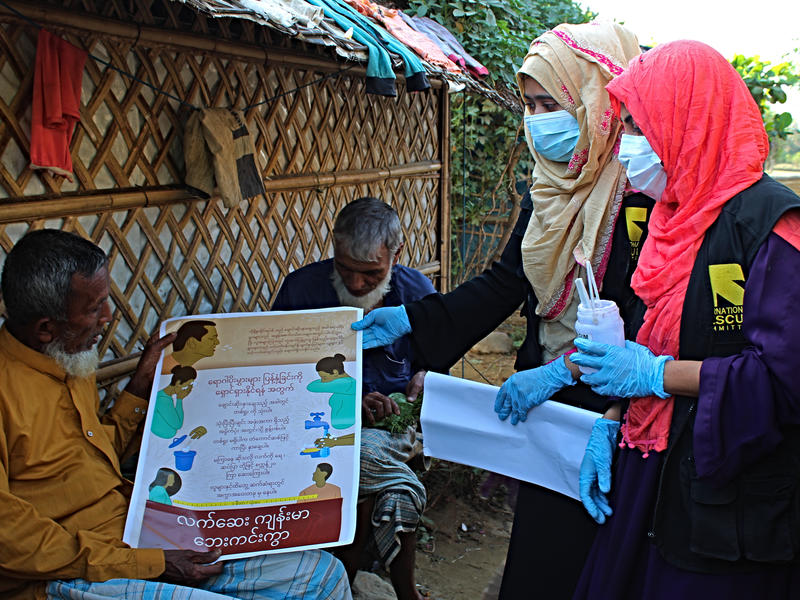
The global population of forcibly displaced persons, numbering more than 70 million by the end of 2018, is highly vulnerable to COVID-19. For example, Cox's Bazar in Southern Bangladesh is, as of this writing, home to almost 860,000 stateless Rohingya refugees, the vast majority of whom reside in densely populated camps. This paper documents the health status and behaviours of the refugees and the host population, providing data on the prevalence of COVID-19 symptoms, risk factors, and information seeking and prevention practices in a humanitarian setting. The researchers hope that these data can inform guidance on the design of behavioural change interventions around COVID-19 in Cox's Bazar.
Between April 11 and 17 2020, the researchers administered a phone-based survey to a sample of 909 households in Cox's Bazar that was drawn from a household panel representative of Rohingya refugees and the host population. They conducted a symptoms checklist to assess COVID-19 risk based on World Health Organization (WHO) guidelines. The survey included questions covering returning migration, employment, and food security, and it asked additional questions on health knowledge and behaviours to a random subsample (n=460).
Results indicate (see the full paper for more data):
- 24.6% of camp residents and 13.4% of those in host communities report at least one common symptom of COVID-19. Many are at high risk due to underlying health conditions that make them more susceptible. The presence of returning migrants, respondent mobility, and food insecurity strongly predict COVID-19 symptoms.
- Gender is the second strongest predictor of COVID-19 symptoms, with women being significantly more likely to report at least one symptom. (The researchers conjecture that the gender gap in self-reported symptoms is partially explained by differences in willingness to report ill health. It has been previously reported that fear to be perceived as weak or a hypochondriac makes some men reluctant to report symptoms and seek treatment.)
- For those who experienced at least one symptom of any health condition, pharmacies were the first stop for advice and treatment (69.6% and 42.3% in host communities and camps, respectively, p < 0.001).
- A survey module administered to a subsample of respondents revealed that trusted sources of advice on COVID-19 prevention vary greatly across refugees and hosts, but information provided by friends and acquaintances is important for both (58.8% and 62.9% of respondents, respectively, p=0.437). Among refugees, non-governmental organisations (NGOs) are also trusted sources (53.5%), followed by informational campaigns on the street (41.6%) and local leaders (e.g., block majhees). Among hosts, newspapers, radio, and TV are the most trusted sources of information (81.4%), and social media is cited by many (51.7%).
- While the majority of respondents demonstrate correct knowledge when asked about the importance of good respiratory and household hygiene practices, and most report good respiratory hygiene, between 76.7% (camps) and 52.2% (host community) had attended a communal prayer (e.g., Friday Jummah prayer) in the previous week. Despite their limited participation in paid employment, attendance to religious services at prayer halls is much higher in camps; this suggests that a lack of knowledge about COVID-19 does not appear to explain the continued participation in communal gatherings. Another 47.4% (camps) and 34.4% (host community) had attended a non-religious social gathering.
- There is some evidence that fear is breeding stigma in some communities. Nearly one-third of refugees and hosts (30.9% and 35.1%, respectively, p=0.406) report that suspected carriers of COVID-19 were prevented from receiving treatment in their community.
The results offer some directions for policy responses that encourage preventative behaviours without threatening the livelihoods of the economically poor, including:
- Work with Imams to advocate for alternatives to communal prayer that have been widely adopted in other parts of the Muslim world.
- Ensure that pharmacists on the front lines of the pandemic in Cox's Bazar are provided with sufficient PPE and training to treat and educate their patients about COVID-19, including to identify and correct false beliefs so as to help reduce stigma and its negative effects on those affected by COVID-19.
- Because friends and acquaintances are among the most trusted sources of information, social influence interventions – for instance, where members of the general public are incentivised to share information about the disease and protective behaviours - may be fruitful.
In addition, research and health screening programmes relying on self-reported data to identify potential hotspots of COVID-19 should consider focusing on men and adapting the design of their interventions to account for attitudes that make them reluctant to report symptoms.
[Preprint]. Bulletin of the World Health Organization. E-pub: 11 May 2020. doi: http://dx.doi.org/10.2471/BLT.20.265173 - sourced from email from Dr. Ahmed Mushfiq Mobarak to The Communication Initiative on May 13 2020 and IPA website, May 14 2020. Image credit: Maruf Hasan/International Rescue Committee (IRC)