










































The Refugee Journalism Project
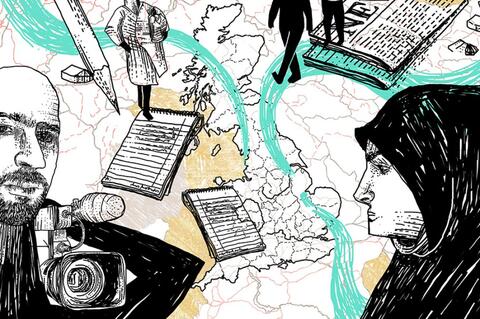
"At a time when the British press has a ready use for stories about refugees, it has yet to make space for stories by them....The story by the refugee journalist needs to be heard - not just for its own sake but to address the imbalance in our coverage of a complex issue." - Vivienne Francis
A collaboration with the United Kingdom (UK)'s Migrants Resource Centre and The London College of Communication (LCC), The Refugee Journalism Project is an effort to assist refugees who were journalists in their country of origin. To date, the project has recruited more than 30 participants from Syria, Sudan, Eritrea, Afghanistan, Iraq, Iran, Cuba, Pakistan, Bangladesh, and Yemen. All have successfully completed the asylum process and have confirmed refugee status. Each month, organisers are approached by more migrants hoping to join. Project participants are mentored by UK journalists, receive training, and participate in workshops to introduce them to the UK market and work experience in a UK media outlet. The aim of the project is to help the journalists gain employment in the UK and, in so doing, to break down the stigma and stereotypes of refugees in the UK media.
One of the central features of the project is the pairing of the refugees with established journalists and media professionals. The lack of access to a network has been frequently cited as a barrier to their progress. Participating mentors have worked for BBC, CNN, Vice, Channel 4 News, The Telegraph, New Statesman, Sky News, The Times, The Economist, and Vanity Fair. The mentors tailor their guidance according to the mentees' needs - some are working on pitches to take to commissioning editors for radio documentaries, investigations or feature articles; others are spending the time developing their curricula vitae (CVs) or undertaking career planning.
The words of lifestyle journalist and lecturer Rob Sharp, one of the mentors, can help shed light on the strategy. As part of the work, he has mentored Azizrahman Omid Azizi and become involved with Afghan Voice, a digital radio platform that provides news on the radio for the thousands of Afghans living in the UK. Sharp says that this experience "has fostered the start of a collaborative working partnership with an inspirational community media organisation, who achieve meaningful results - often in several different languages - that beat on insight, and effect, much larger institutions....Observing the work of Afghan Voice, which broadcasts to the Afghan diaspora here and listeners in Afghanistan, highlights the obvious benefits of digital technology in allowing real time, hard-hitting news-oriented programming on a budget that should make mainstream media organisations blush. Their offer challenges and explores the complex political situation in Afghanistan as it develops daily, fielding questions from listeners to put to major Afghan political figures. In doing so, the organisation fulfills an obvious public service remit for the 60,000 Afghans in the UK, and many abroad....I have ... [been] ... offering media workshops to Afghan Voice volunteers, many of whom have arrived in the UK recently, drawing on my teacher training at the London College of Communication and applying this to planned workshops in news production, reporting, public affairs and media law, looking at life in the UK more broadly, and providing support for the organisation's multimedia offer. These workshops will lead to some interesting discussions over the course of the next year, as well as further opportunities to tell the stories of Afghan people in Britain. I have supplemented the above by meeting with Azizi to discuss his priorities in moving forward with both his media career and his life in the UK, offering support where I can, and planning some ways that I can help him, in a form ultimately directed by him."
Each month, the project runs journalism workshops on a range of topics. For example, in April 2016, a session led by Dr. Abel Ugba from the University of East London explored the concept of universal values in journalism. Later that month, journalist Neil Arun delivered some sessions around pitching and developing ideas. The group vented their frustration at the dehumanisation of the refugee story and the need to change the stereotypical narrative of migrants jumping off boats and trucks. Over that summer, the project held other sessions in UK media law and personal publishing platforms. Upcoming workshops will focus on topics such as investigative skills and data journalism. There is also a trip planned to the Guardian to meet journalist Gary Younge.
In terms of the internship component, for example, 2 participants have interned at Airwars, a group that monitors civilian deaths from drone strikes. They were invited to apply for a paid researcher post within the organisation. In addition, 2 participants have completed paid internships with the Thomas Reuters Foundation, 2 have started paid internships with Timetric, and others have had articles published in the Huffington Post, the Guardian, and Media Diversified.
Journalism undergraduate students at LCC have volunteered to work alongside the refugee journalists - supporting the project website and filming activities. This enables the students to gain a more transcultural awareness of journalism and helps them to develop their interpersonal skills.
Migration
Organisers explain: "There are a number of layers to our expectations for the project. From a journalistic perspective, we hope to help change the narrative around refugees and migrants - too often they are cast as terrorists, parasites or victims. For those who are 'work ready', we want them to be able to successfully compete for paid work. But the project is not just about finding them work and developing their journalism skills. For some, there are more fundamental barriers that need to be tackled. The trauma of the last few years has left some in need of emotional healing. Others have complex challenges around housing to work through. So the project is also about building offering practical support, rebuilding confidence and reducing feelings of isolation. Ultimately, its also about supporting their broader integration into the UK. We want to help them thrive and resettle their lives in their new communities."
MRC was established in 1984 to: run classes, courses, and social activities; to offer advice; and to provide a voice for migrants and refugees. Since its first days, MRC has maintained its vision of a society where migrants are valued and able to contribute. MRC works with other organisations and networks to better serve its clients and expand its reach. Ukrainian Migrants Network is one of them. Oleg Pasichnyi, coordinator for Ukrainian Migrants Network, believes that networking with other organisations not only helps the staff to become aware of what other organisations do, but also expands the reach of the organisation in providing services to wider communities and more people.
Migrants Resource Centre, The London College of Communication. The Esmée Fairbairn Foundation has funded the project for one year.
Emails from Tessa Hughes to The Communication Initiative on September 6 2016 and December 20 2016; and The Refugee Journalism Project website, September 19 2016.
- Log in to post comments