










































Radio and SMS To Increase Awareness on Deforestation
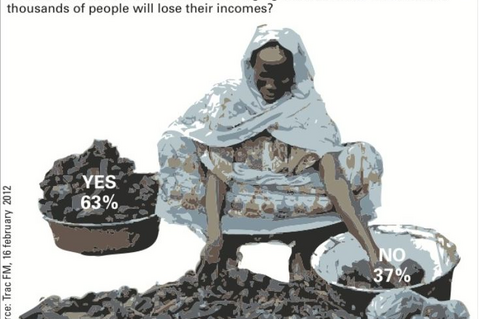
In February 2012, Text to Change, World Wide Fund for Nature’s Earth Hour, and Trac FM collaborated to use mobile technology and radio to address the impact of the charcoal trade on deforestation in Uganda. Two radio stations in Uganda asked their listeners to participate in polls which focused on the country's charcoal trade in order to find out their opinion. Participants were able to respond on a toll free short code. The results were instantly available to in-studio guests, and were subsequently published in other media.
Trac FM is a programme specialising in strategies to involve people in monitoring service delivery in their community through radio polls. Responses to the polls are instantly visualised in the radio studio so talk-show hosts can discuss the real time data with their guests and give feedback to listeners on what is happening on the ground. The survey, in which 187 people responded, found that 83% of the participants in Northern Uganda think that the making of charcoal should be restricted to save the forest. In the Kampala area, 63% believe that it should be restricted even if thousands of people will lose their incomes.
Participants who responded to the first question received a second question about how they want to help themselves in safeguarding the Ugandan environment. Again participants could respond on a toll free short code. Responses included such promises as: I shall plant trees; I shall stop using plastic bags; and I will not throw garbage on the streets. Participants received additional information on environmental issues and were offered a discount on the purchase of energy efficient stoves and Firefly solar panels, courtesy of WWF. This "I will if you will" campaign produced over 1200 pledges from all over Uganda. Text to Change and WWF are planning to follow-up on the promises made by calling those who made a promise and asking them to check if the promise has been realised yet.
Poll results from this survey were also published in newspapers and magazines in Uganda. This multi-layered campaign involved NGO's, private sector, citizens, and media, in a joint effort to fight deforestation and, according to the organisers, shows that collaboration between different stakeholders can seriously increase effectiveness in awareness campaigns.
This initiative was initiated for the Global Earth Hour 2012 campaign.
Deforestation, Environment, New Technologies
According to World Wide Fund for Nature, Uganda loses close to 73,000 hectares of forest cover annually, which according to some experts, has been the country’s biggest climate threat. At the centre of deforestation is the lucrative charcoal trade. An estimated 95% of Ugandans depend on charcoal and wood for cooking and many people in Uganda are making a living from this trade, also known as the 'black gold' trade. The lucrative charcoal trade is not only wreaking havoc on forests but also on its most famous inhabitants, the rare gorillas.
Trac FM's platform has been used in radio broadcasts since May 2011. The TRAC FM project is based on ethnographic research on the use of ICT for accountability (ICT4Accountability) conducted in Uganda. ICT4Accountability is defined as a distinct form of civic media which uses ICTs to systematically collect, process, and deliver accurate, comprehensible, and direct data with the purpose of assisting citizens in making objective assessments of the performance of who-ever is taking action on their behalf.
Text to Change, Trac FM, World Wide Fund for Nature
Text To Change website on March 17 2012.
- Log in to post comments