










































Radiophonics (formerly Crossing Borders)

Crossing Borders, out of which Radiophonics emerged, was a cross-cultural distance-learning project for young African writers working in the fields of poetry, prose, fiction, and children's writing. Each writer on the programme programme was linked to an experienced professional UK writer who gave close attention to participants work through email exchange. At the end of the email exchange, visiting writers delivered a series of live writing workshops and public readings. A portfolio of new writing was developed and revised. The programme operated in Cameroon, Ghana, Kenya, Malawi, Nigeria, South Africa, Uganda, Zambia, and Zimbabwe. The project aimed to break the isolation of young African writers, promoting writing development, library usage, cultural exchange and knowledge of contemporary literature in English. It also aimed to enrich the lives of writers in the UK working as mentors on the programme.
As part of the initial Crossing Borders project, the project ran various workshops:
- Prose Online Workshop: This workshop was intended for writers who wanted to develop their skills in short fiction or non-fiction. The emphasis of the workshop was on shaping and revising short prose pieces for magazine publication. Two discussion groups - five writers and one mentor - ran simultaneously, allowing writers to participate in parallel discussions on writing and revising the short story. Participants were able to see both groups in the Discussion Boards area of the website. These workshop groups continued for 5 weeks, with a sixth week of writing and reflection followed by a seventh week of general discussion.
- Poetry Online Workshop: The Online International Poetry Workshop was intended for writers who wanted to develop their poetry skills. A Writing Library within the Discussion Boards area provided a range of articles and links with advice about re-drafting and polishing work, as well as links to online magazines and poetry competitions. Two discussion groups - six writers and one mentor - ran simultaneously, allowing writers to participate in parallel discussions on writing and revising their poetry. These workshop groups continued for 5 weeks, with a sixth week of writing and reflection followed by a seventh week of general discussion.
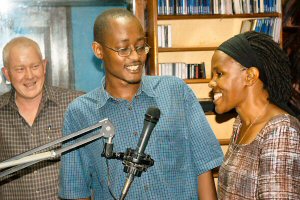
Crossing Borders was then absorbed by Radiophonics, a writing initiative focusing on radio. The Radiophonics programme in Uganda started with an online workshop in October 2006 with writers from Uganda. For the 10-day period, participants worked in a group led by experienced writers, enabling the development of eight 10-minute short stories for radio. At the beginning of the workshop, each writer submitted one piece of work of approximately 1,300 words that was critiqued by the other writers and briefly commented on by the moderator. After the first 5 days, participants revised their pieces according to comments made by participants and mentors and incorporating ideas raised during the discussion. At the end of this period, the pieces were revised as tightly as possible in order to be ready for radio production. The 2 mentors and eight participants developed a series of short stories for radio. The series, called "Under the Sun", was then featured by a local radio station and podcast on the Radiophonics website (no longer in operation as of September 30 2009). In 2008 the Ugandan Radiophonics project concentrated on producing educational resources for teachers to use in schools to teach creative writing. The selected Uganda schools were involved in the British Council Connecting Classrooms project.
Radiophonics was started in Nigeria in 2008. The aim of the Radiophonics creative writing workshops was to generate stories suitable for radio broadcast across Nigeria which related to social issues with the aim of informing debate and discussion.
Youth, Education.
British Council, Lancaster University.
Radiophonics website on April 27 2009 and September 16 2009 (no longer in operation as of September 30 2009); and email from Macey Marini to The Communication Initiative on September 16 2009.
- Log in to post comments