










































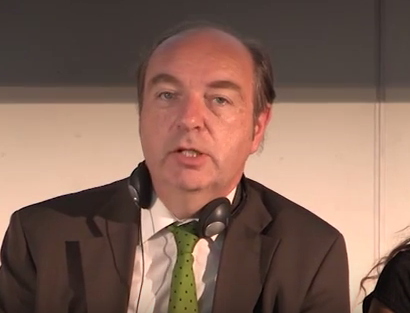
[The Ret Hon] Norman Baker, MP [Former] Minister of State for Crime Prevention, Government of the United Kingdom - DFID Girl Summit 2014
Spotlight B2 - "Bringing it all Together: Ending FGM Through Strong and Effective National Action"
Context: This presentation is from one of the 14 "Spotlights on Progress" video-recorded sessions from the Girl Summit 2014, London, United Kingdom (UK). The sessions were organised to share best practice between practitioners, grassroots activists, and government ministers across the issues of female genital mutilation (FGM) (also FGM/C - female genital mutilation/cutting) and child, early, and forced marriage (CEFM). The Girl Summit is a project of the Department for International Development (DFID), UK.
Profile of speaker: [Editor's note: According to the UK Government website, Norman Baker was appointed Minister of State for Crime Prevention in October 2013. He resigned approximately a year later (after the Girl Summit). He is currently the Liberal Democrat MP for Lewes.] In his position as Crime Prevention Minister at the Home Office, he was the lead minister for the coalition government's domestic policy on FGM.
Strategy overview: In his presentation "UK's National Action on Ending FGM", which can be viewed in the video below, Mr. Baker noted that the UK passed the Female Genital Mutilation Act in 2003; however, legislation alone cannot eliminate the practice. The UK Government's focus is prevention. The UK Government recognises that a joined-up approach across front-line agencies is needed to safeguard girls and protect women. Thus, it has initiated cross-departmental working between the Home Office, Department of Health, Department of Education, and the Foreign and Commonwealth Office.
The UK government has also been working more closely with front-line professionals including doctors, nurses, teachers, and social workers, who are (as of April 2014) required, per the National Health Service (NHS) to carry out mandatory reporting of FGM/C. This follows up on the launching, in February 2011, of multi-agency practice guidelines for front-line professionals.
The UK Government also recognises the importance of data. In addition to the mandatory reporting described above, the Home Office financed a FGM prevalence study that was released in July 2014.
Stemming from the belief that ending FGM in the UK will require the government continuing to work with civil society organisations in practising communities to abandon the practice themselves, the UK government was (at the time of this presentation) allocating €300,000 to the voluntary sector so that those potentially affected by FGM could also seek advice from less formal channels.
Finally, Mr. Baker stressed the important role that the media had played in raising awareness about FGM, notably the Evening Standard, Guardian, and the Times.
According to "Highlights of Government Progress since the Girl Summit towards the Elimination Female Genital Mutilation and Child and Forced Marriage" [PDF], "At Girl Summit 2014, the UK government announced an unprecedented package of measures to tackle FGM and child, early and forced marriage. Since the Summit, the UK has delivered on these commitments.
Domestically this has meant:
- Strengthening the law on FGM significantly, including introducing an offence of failing to protect a girl from risk of FGM, FGM Protection Orders, and mandatory reporting of FGM by relevant professionals.
- Establishing a dedicated FGM Unit which provides outreach support to local areas, and coordinates activity across government.
- Providing resources for frontline professionals and distributing over 440,000 communication materials.
- Funding a £3m national FGM Prevention Programme with a package of measures to support NHS staff in preventing FGM, protecting girls at risk and caring for survivors.
- Securing signatures from over 350 leaders of every major religion in the UK to a declaration to make clear that no faith condones FGM.
- Launching a force level inspection on the police response to Honour Based Violence with a focus on FGM and forced marriage.
- Funding a programme to bring together experts on FGM to support local authorities and 29 community prevention and awareness projects, including supporting a network of over 60 community champions.
Internationally:
- The UK has launched a £36 million programme to accelerate action to end child marriage, including £8 million for civil society working on sexual and reproductive health and rights overseas.
- The UK has strengthened implementation of its flagship £35 million programme to tackle FGM, including launching the social change and research components of the programme."
Overview of this Summit session: Speakers from African and European countries came together in this session to discuss what they have done to ensure coordinated and comprehensive national action towards ending FGM in their own countries and seek insight from each other's experiences. They talk about how they have creatively brought together diverse groups to achieve consensus on what needs to happen to end FGM, highlighting critical steps towards success as well as challenges. Following an opening by Cathy Russell, Ambassador-at-Large for Global Women's Issues, United States, the speakers, in order of appearance, are:
- Hon. Dr Linah Jebii Kilimo, Chair of the Anti-FGM Board, Kenya
- Dr. Alain P. Zoubga, Minister for Social Action and National Solidarity, Government of Burkina Faso
- Norman Baker, MP Minister of State for Crime Prevention, Government of the United Kingdom
- Zsanett Shashaty, Anti-Slavery Officer for the Welsh Government
- Vitor Almeida, Senior Advisor in the Portuguese Commission for Citizenship and Gender Equality, Government of Portugal
- Dr. Morissanda Kouyate, Executive Director, Inter-African Committee on Traditional Practices
The session was moderated by Susan Bookbinder, who is a journalist, broadcaster, columnist and media consultant with a particular focus on FGM.
Footage of this (available below) presentation and others are available on DFID’s YouTube channel.
The Girl Summit is a project of DFID. Click here and scroll down to see the full list of individuals and organisations committed to working on girls' issues, as well as a list of Girl Summit Charter signatories.
- Log in to post comments