










































South Africa Clothesline Project
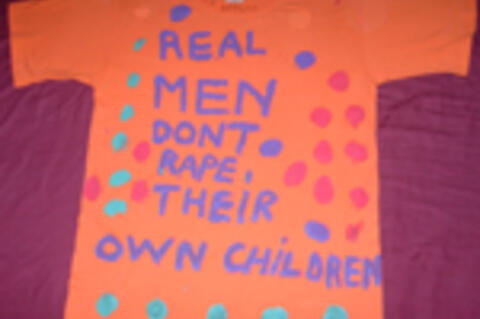
When the idea of the South African Clothesline project first arose in 2001, it received widespread enthusiasm due to the combined use of the t-shirts to generate awareness while simultaneously giving women whose lives are or were directly impacted by violence a venue to speak out. According to the project, it provides a means to subvert the silences imposed on women and the messages give women and their families, friends and colleagues a means to empower themselves as survivors. The form and variety of the messages also encourages discussion and conversation about the issues.
The organisers discussed how to alter and adapt the idea, which originated in the United States, to suit the situations and circumstances of women’s lives in South Africa’s many social, political, geographical, and other contexts. The collaborating organisations then contacted their network’s member organisations to invite participation. Women from a variety of service venues such as the National Institute for the Criminal Rehabilitation of Offenders, elementary and secondary schools, Women on Farms, academic programmes, shelters, and rape crisis one-stop centres participated. By November 26 2001, for the launch of 16 Days to End Violence Against Women, almost 700 individual t-shirts had been created.
The Clothesline consists of t-shirts on which women, and/or their families, friends, and colleagues have written messages. As the organisers commented in relation to the first campaign, the messages broke barriers of form, politics, artistic skill, customs, and literacy as truths were spoken on the fronts, backs, and sleeves of the shirts. Each shirt is part of the whole clothesline, and no shirt hangs alone. Creation was also part of a collaborative, coordinated process sponsored by a non-government organisation (NGO), an academic programme, a Gender Equity Unit, a crisis centre, a community-based organisation, or a similar group. While individual women might have chosen to work on their t-shirt messages/designs on their own, the shirts were not produced in isolation.
The Clothesline is meant to be hung at public venues, such as libraries, court houses, musical venues, national holiday events, public roadways, prayer services, universities, etc. Today, many of the t-shirts hang permanently at the Sarah Saartjie Baartman Centre for Women and Children.
In 2007, again as part of the annual 16 Days to End Violence Against Women, partner organisations at the Saartjie Baartman Centre organised another Clothesline campaign. At a ceremony on November 30 2007 the t-shirts were hung on the fence of the centre's grounds. A further campaign took place at the Saartjie Baartman Centre on December 11 2009, as part of the Centre’s 10th birthday celebrations. This time, 200 children from neighbouring schools were invited to join the shelter children to spend a morning painting their messages on t-shirts. Aided by a group of artists who volunteered their time, the children painted t-shirts and played games. Each child also wore a slapper band on their wrist, proclaiming that "violence ends here."
According to the organisers, the colour of the t-shirts can also be signficant. The organisers suggested, but did not prescribe, the use of colour codes to represent different levels of violence. For example, white signified women who are or have been in abusive relationships; red was for women who have been raped; green for women raped, killed, tortured, or harassed during the struggle; blue for providers who work in the field of violence against women; yellow for relatives of women who were killed or where attempts to kill them had been made by men known to them; pink for child victims of incest/ sexual abuse; and orange for gender violence because of sexual orientation or those experiencing abuse in same-sex relationships.
The Saartjie Baartman Centre will hold another "Air your dirty laundry" Campaign for schoolchildren on December 3 2010 as part of their 16 Days of Activism events. This is in order to raise awareness of the increasing levels of violence against children, as well as the lack of services/resources available to women and children.
Gender-based Violence, Rights.
The Northern Cape Network was presented with the Northern Cape Parliamentary Award for the Most Informative Display in 2001 for their Clothesline, which was hung in the Provincial Parliament Building in Kimberley, South Africa.
The Saartjie Baartman Centre for Women and Children, the Western Cape Network on Violence Against Women, the National Network cluster of Western Cape, Northern Cape, and Eastern Cape Provincial Networks.
Isis International website and Saartjie Baartman Centre for Women and Children website on October 21 2010 and email from Synnov Skorge on October 26 2010.
- Log in to post comments