










































South Project
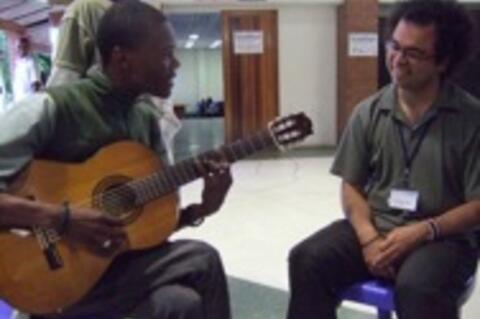
Held from July 1-4 2004, South 1 was the initial gathering of representatives from participating countries. The principal aim of this forum was to bring together individuals and organisations that may be able to work together in a south-south network. Approximately 50 individuals from Fiji, Papua New Guinea, Vanuatu, Brazil, South Africa, and Mali began the process of forging partnerships at the city, state, national, and international level; they then brought back ideas and opportunities to their home countries. The gathering was meant to provide an opportunity to learn what is happening in other places and to consider what role Australia might play as a southern nation. It featured a number of speakers, including the keynote address "Beyond Mythification: Constituting a Southern Identity".
Various events were planned in association with South 1 in an effort to involve members of the public in the understanding and creation of southern art. For example, in June 2004, two participants in the Project's "Maker in Residence" programme - one artist from South Africa and one from Chile - held exhibitions and participatory events at the children's art centre, Artplay. Michael Mbata, a Zulu artist, worked with children to create a model of his village (Mkhambethini). Guillermina Antunez, a Chilean silversmith, introduced children to traditional Mapuche techniques using stones. The makers also held public workshops for children. One focus of the South Project is on the way craft can be used as a means of communication between city-based makers and craftspersons from remote communities.
In addition, to complement the range of activities offered by South 1, a series of workshops provided an opportunity for the public to engage with the large number of Australian and international guests who had gathered in Melbourne. The workshops were run by a diverse range of practitioners living and working throughout the southern hemisphere who specialise in different mediums and disciplines. Each workshop was designed to share skills particular to a specific location or culture of the south.
An artistic programme was developed to showcase a broad range of artistic practice, including the visual arts, digital media, film, poetry, and performance art. This programme provided an opportunity for the public to visually explore some of the issues and stories celebrated through The South Project and to interact with a variety of artists from a diverse range of backgrounds.
South 2 is an extended period for exploring the possibilities of south-south dialogue. The South Project will nurture these possibilities by profiling projects through its communications and network. These projects may involve collaboration between artists in different southern countries or creative work that connects these different countries/cultures. South 2 featured this work through exhibitions, publications, workshops, residencies, and performances.
To access details about all the South gatherings, click here.
Cultural Exchange.
In 2001, Craft Victoria's Director traveled to South Africa and New Zealand. The South African trip uncovered a series of new practices that reflected a post-Apartheid nation, including hybrid crafts, healer artists, transitional artists, and those reflecting on the ironies of tribal capitalism. This vibrant cultural scene was almost invisible to Australia, where the only news from South Africa concerned social disorder. Similarly in New Zealand, there seemed a rich dynamic of Maori and Pakeha cultural expression that was often overlooked across the Tasman.
The South Project is managed by Craft Victoria. It is supported by Australia Council, Australia Council for the Arts, the Myer Foundation, the Ian Potter Foundation, and the City of Melbourne.
Overseas partners: Creative New Zealand; Dirección de Asuntos Culturales (DIRAC), Ministerio de Relaciones Exteriores del Gobierno de Chile Cultural Affairs - Division, Ministry of Foreign Affairs, Government of Chile; Australia-India Council; Torres Strait Arts Board; Alliance Francais; Centre for Scientific and Industrial Research (South Africa); Whitespace (New Zealand); Artesanato Solidário (Brazil); Trama Artist Network (Argentina); Pulse Artist Network (South Africa); The African Arts Centre (South Africa); Te Papa (New Zealand).
The South Project website (Image Credit: © Tayla Chalef 2007).
Comments

- Log in to post comments