










































Vaccination Week in the Americas

Collaboration, accomplished mainly through face-to-face planning sessions, informs the communication strategy. For example, in preparation for the first of the 2004 week-long events (April 24-30), participating countries (every country in the Americas) - outlined their plans and activities at a meeting held early in 2004 in Quito, Ecuador. Each country set out goals, deciding which antigens should be used and which areas should be targeted. The countries identified areas of high risk and exclusion as poor peri-urban areas, borders, indigenous regions, areas with displaced or isolated populations, and tourist areas. In addition to ending measles, several of the countries explained that their strategy would be shaped by efforts to end rubella, known as German measles.
Based on this discussion, most of the countries opted to conduct events in border areas. The majority of the countries planned to vaccinate children under 5, along with women of childbearing age and senior citizens. Many of the countries began planning launches, walks, and health fairs. In the Caribbean, for example, most countries set up committees to coordinate events. Radio spots were to be produced in indigenous languages and dialects for several countries, with materials targeted to address those living in specific areas. The United States and Canada announced that they would organise informational events seeking to increase the number of children who receive vaccinations against preventable illnesses. To cite one example, as part of the August 2004 Border Immunization Week (a continuation of the hemisphere-wide April vaccine drive), United States (US) Surgeon General Dr. Richard Carmona held a news conference in San Diego, California (US) to encourage the public to participate in health fairs and community events designed to motivate them to "leave no child behind" when it came to vaccinating those living along the USA-Mexico border. In October 2004, sister cities in Mexico joined the immunisation effort as part of the Healthy Border 2010 programme.
Campaign themes tend to draw on people's concern for others. In 2003, participating countries rallied around the theme "Vaccination: An Act of Love." In 2004, the countries agreed to include the U.S. Centers for Disease Control and Prevention (CDC) theme "Love Them, Protect Them, Immunize Them."
In an effort to engage with a ride range of individuals, PAHO has used social media as part of the VWA communication strategy. As part of the 2016 VWA celebration, PAHO hosted Tweet chats using the hashtags #GetVax and #Vacunate to engage with partners and the general public on the importance of vaccination. Centring on the messages that vaccines are safe, effective, necessary, and cost-effective, the PAHO team took to Twitter to answer questions from the public and dialogue with partners such as the US Centers for Disease Control and Prevention (CDC), the Public Health Agency of Canada, Immunize Canada, the American Academy of Pediatrics, the UN Foundation's Shot at Life, the Sabin Vaccine Institute, and Vaccine Ambassadors. Ministries of health and clinics throughout the Region also participated. Separate Tweet chats were held in English and Spanish. During VWA, PAHO country offices in Argentina, Honduras, and Peru also hosted national Tweet chats with the hashtag #Vacunate.
For further details about current and previous campaigns along with associated reports, materials, and events, click here.
Immunisation and Vaccines.
Border areas are one focus of this initiative, as they tend to have lower coverage. For example, the USA-Mexico Border states have lower vaccination coverage, at an average of 70% for children under 3 years old, than national standards, according to the CDC.
VWA was first held in 2003. PAHO sent out radio and television spots, posters, and news releases to the media to promote the week. On-site evaluations indicated that most parents heard about the 2003 vaccination week on radio or television. Several entertainers, including TV celebrity Don Francisco, offered their time to promote the event. The idea originated in the Andean region when ministers of health agreed to boost declining vaccination rates. The initiative grew to include 19 countries, where some 15 million children were vaccinated. For more details about the 2003 event, including press releases, graphic material, videos, and stickers, click here. In 2004, the initiative was extended to all the region's countries.
Since the first celebration of VWA in 2003, hundreds of millions of individuals of all ages have been vaccinated against a wide range of vaccine preventable diseases such as measles, rubella, yellow fever, diphtheria, tetanus, polio, and influenza, through activities conducted under the framework of the initiative. Multiple VWA social mobilisation campaigns have also been undertaken throughout the region, and the initiative has received ever-increasing political support.
A brief history (for a more complete history and links to each year's website, supporting materials, reports, etc., click here.)
- 2002 - Prompted by a measles outbreak in Venezuela and Colombia, the health ministers of countries in the Andean region proposed an annual VWA.
- 2003 - In September, VWA was accepted as an annual, hemispheric initiative by the Directing Council of PAHO.
- 2004 (April 24-30) - The focus of the second region-wide VWA consisted of follow-up campaigns against measles, elimination of rubella and congenital rubella syndrome (CRS), and the vaccination of older adults.
- 2005 (April 24-30) - The third VWA emphasised the vaccination of indigenous peoples and older adults, rubella elimination campaigns, the strengthening of regular immunisation programmes, and the introduction of new vaccines. Drawing inspiration from the activities in the Americas, European Immunization Week (EIW) launched in October 2005 - with a primary focus primarily on social communication activities.
- 2006 (April 22-29) - In its fourth year, VWA activities highlighted the transition from child to family immunisation programmes, the strengthening of regular immunisation programmes, influenza, rubella elimination, and the introduction of new vaccines.
- 2007 (April 21-28) - 45 countries and territories participated. More than 47 million individuals were vaccinated as a result of the week's initiatives, which worked to strengthen border coordination, reach isolated populations, strengthen routine programmes, and advance the control of yellow fever and hepatitis B, among other goals. More information on VWA's 2007 activities, and the final report can be found by clicking here.
- 2008 (April 19-26) - 45 countries and territories in the region again took part, with multiple VWA launching events along binational and trinational borders under the framework of a Health Caravan and with the participation of high-ranking authorities. Diverse arrays of vaccination campaigns took place as part of the week, including multiple measles/rubella elimination campaigns, focused primarily in Central America. More than 59 million individuals were vaccinated through such efforts. The final report of VWA 2008, which contains more information about realised campaigns and VWA social communication activities, can be found by clicking here.
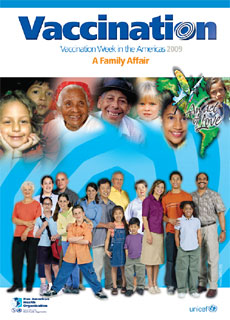
- 2009 (April 25 - May 2) - The seventh annual VWA emphasised themes including the importance of family vaccination as well as the vaccination of health workers. Multiple launching events took place throughout the region, including a series of events in the South American Chaco, the border area shared by Argentina, Bolivia, and Paraguay and one of the transnational priority areas as identified by the Pan American Alliance for Nutrition and Development.
- 2010 (April 24 - May 1) - The eighth VWA was celebrated under the slogan of "reaching everyone". Regional events were held in multiple locations, including Nicaragua, the Haiti/Dominican Republic, and the Suriname/French Guiana border. The latter was the first ever bi-Regional launching event, linking both VWA and EIW. In 2010, the Eastern Mediterranean (EMRO) Region of the World Health Organization (WHO) celebrated its first ever Vaccination Week in the Eastern Mediterranean (VWEM).
- 2011 (April 23-30) - The slogan of the ninth annual VWA was "Vaccinate your family, protect your community". Regional launching events were organised throughout the Amazon sub-region, and between Peru and Bolivia in the Altiplano. In 2011, the African and Western Pacific WHO Regions celebrated their first ever vaccination week initiatives.
- 2012 (April 21-28) - The 10th VWA was celebrated in conjunction with the first ever World Immunization Week (WIW), under the respective themes of "For you, for me, for everyone. Get vaccinated" and "Protect your world, get vaccinated". In May 2012, the future celebration of WIW was endorsed through a resolution during the World Health Assembly.
- 2013 (April 23-30) - The regional slogan was: "Vaccination: A Shared Responsibility." Events were held in the majority of countries throughout the Region. Many of these celebrations included the participation of both high level authorities and local leaders.
- 2014 (April 26 - May 3) - The slogan "Vaccination: Your best shot" was chosen to encourage people to protect themselves and the Region against the importation of polio, measles, and other vaccine-preventable diseases in the context of the 2014 World Cup in Brazil.
- 2015 (April 25 - May 2) - The 13th celebration of Vaccination Week in the Americas (VWA) took place from 25 April – 2 May 2015 with the regional slogan: "Vaccination: Boost your Power!"
- 2016 (April 23-30) - In the lead-up to the Olympic Games in Brazil, the regional slogan for VWA 2016 was "Go for the gold! Get vaccinated!" This VWA also coincided with a worldwide switch to a new polio vaccine coordinated by WHO and its partners in the Global Polio Eradication Initiative.
The Government of Spain, United Nations Children's Fund (UNICEF), the Red Cross, United States Agency for International Development (USAID), the Centers for Disease Control and Prevention (CDC), Canadian International Development Agency (CIDA), the Inter-American Development Bank, the United Nations Foundation, and several service clubs such as Rotary International and Kiwanis.
"Every Country in the Americas Joins Vaccination Week" PAHO News Release, February 9 2004 - forwarded to The Communication Initiative by Bryna Brennan; and "Vaccination Campaign Kicks Off Along U.S.-Mexico Border", PAHO News Release, July 30 2004; PAHO website on July 10 2009; and Global Immunization News [PDF], May 2016 and VWA website - both accessed on June 3 2016.
- Log in to post comments