










































Village Phone Rwanda (Tel’imbere)

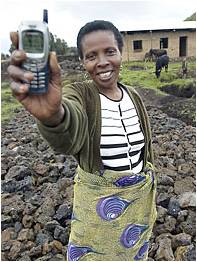
The Village Phone programme is essentially a "business in a box" kit. Village Phone Operators (VPOs) operate their businesses in rural villages where no telecommunications services previously existed. They rent the use of the phone to their community on a per-call basis. The model is based on the idea that VPOs provide affordable rates to their customers while earning enough to repay their loans and earn profits that allow them to make investments in their children’s health, nutrition, education, and in other business ventures.
This “business in a box” kit includes:
- a Nokia mobile phone with earpiece;
- external booster antenna for areas without strong mobile signal coverage; and
- custom designed cables to connect the phone to the antenna and the recharging equipment such as an automobile battery or a solar panel.
To complete the Village Phone Equipment Kit for the microfinance client, a SIM (Subscriber Identity Module) card and prepaid airtime are also needed and can be purchased through regular outlets.
The Grameen Foundation serves as a catalyst and creates the linkage between the telecommunications sector and the microfinance sector to enable microfinance clients to borrow the money needed to purchase a Village Phone business. Since the programme uses existing telecommunications products, microfinance institutions directly implement the programme, define the local marketing strategy, and control all aspects of implementation. They may also produce items such as signage and marketing material.
The basic steps for microfinance institutions to set up the Village Phone programme for customers are:
- Make an institutional commitment to the programme including allocating staff
- Conduct a survey to assess demand and create a business model
- Determine final components and sources for items in the Village Phone Equipment Kit
- Procure all items and set pricing for the Village Phone Equipment Kit and corresponding loans
- Educate clients about the programme
- Conduct a pilot programme
- Refine operational processes and business model
- Expand the programme to all clients
To help support the process, Grameen Foundation authored a Village Phone replication manual, a step-by-step guide for replicating this programme in developing countries. According to the organisers, the manual draws on the work of Grameen Telecom in Bangladesh, where Village Phone first began, and on Grameen Foundation's experience in launching the first replication in Uganda.
Click here to learn more about the project.
Technology, Economic Development.
Village Phone in Rwanda was launched after a year-long pilot with 50 micro-entrepreneurs operating Village Phone businesses.
According to the organisers, access to affordable telecommunications does not exist for millions in the developing world. Cut off from easy access to communications, these communities are at both an enormous economic and social disadvantage. Based on the work of the Grameen Village Phone in Bangladesh, Village Phone makes use of relatively inexpensive technology that can solve many of the problems the economically poor in rural villages have faced for decades. Individuals living in rural communities gain access to affordable telecommunication services linking them to their friends, family, business contacts, and the world. Village Phone Rwanda aims to have 3,000 Village Phone Operators by 2009.
Union des Caisses de Solidarite, d’Epargne et de Credit des Travailleurs (UCT), MTN RwandaCell, Urwego, The Vision Finance Company, CARE Rwanda, and Duterimbere.
Grameen Foundation website on May 16 2008.
- Log in to post comments