










































Zero Tolerance for Corruption Campaign

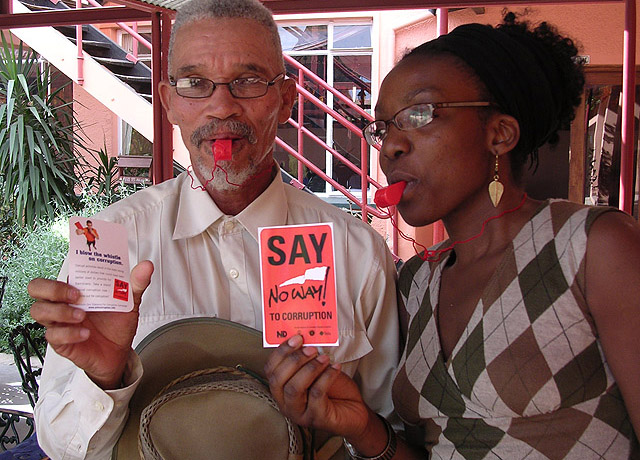
The Zero Tolerance for Corruption Campaign works to reinforce Namibian efforts to address what organisers identified as a growing trend of corruption in Namibia and to maintain the currently still favourable reputation Namibia enjoys within the region and internationally with regard to transparency and integrity. The programme has 3 specific objectives: enhancing public access to comprehensive, accurate, relevant, and current information on corruption through surveys, opinion polls, and media campaigns; strengthening the capacity of institutions, organisations, and networks that address corruption-related issues; and stimulating overall capacity and willingness of all Namibians to participate in government and civil society structures to ensure transparent governance.
Between January 2007 and May 2010, the following interventions have been conducted to serve the objectives of the programme:
- Technical assistance was given to local authorities to support the implementation of the integrity system on the local authority level. This involved workshops on ethics and integrity.
- Anti-corruption workshops for non-governmental organisations (NGOs), civil society organisations (CSOs), faith-based organisations (FBOs), and schoolchildren were conducted across Namibia to raise awareness about corruption-related issues and to shape people's attitudes around corruption. The workshops also aimed to inform people about their rights and the laws protecting these rights. Examples include:
- The campaign conducted workshops with representatives of FBOs, as pastors often work as confidants and spiritual caregivers to the members of their congregations. As they have a regular audience and moral authority, they are considered to be ideal multiplicators (they pass on knowledge to their parents and friends) for integrity-related issues. The campaign found that there were also problems of poverty and corruption among pastors themselves, in particular among economically poor rural congregations. These problems were also addressed during the anti-corruption workshops.
- Anti-corruption workshops were held for schoolchildren, as youth are considered the leaders of tomorrow and function as multiplicators.
- Workshops were conducted in indigenous languages with communities in remote rural regions. Cooperation with traditional and local authorities was meant to ensure local ownership of the interventions.
- In total, over 238 interactive civic education workshops were conducted with communities throughout Namibia between 2007, and 2010 and more than 10,000 people were reached.
- Investigative journalism workshops were held for media representatives and media students. These workshops aimed to enhance public access to comprehensive, accurate, relevant, and up-to-date information on corruption and to stimulate the overall capacity and willingness of all Namibians to become involved as citizens by participating with collaborative structures, together with government and other civil society institutions, to ensure transparent governance at all levels characterised by a superior level of integrity. A media survey on "Actual Instances of Corruption as Reported in the Namibian Print Media" was also conducted and was designed to identify trends in the occurrence of corruption and in the print media's reporting on actual cases.
- As part of social marketing initiatives of the campaign, printed educational materials were distributed, radio programmes on corruption were broadcast on all language channels of the national broadcaster (NBC), and regular anti-corruption advertisements were placed in daily newspapers on a regular basis.
Democracy and Governance, Corruption
In accordance with the tenets of transparency and in order to ascertain the effectiveness of the programme in its entirety, continuous monitoring is undertaken at each component level, and intervention is undertaken, as appropriate, to ensure that implementation reactions and reception is as predicted.
Namibia Institute for Democracy (NID), the Anti-Corruption Commission, the Office of the Prime Minister, and other public and private institutions and civic organisations.
Namibian Institute for Democracy website on May 18 2010 and January 31 2011.
Comments

Effective Communication
Corruption is a serious issue in any country. People, even children, must be informed about corruption and its consequences. I come from a country with corrupt officials, and this issue always brings us to the topic of poverty. Proper communication is important for people to be aware that even a small case of bribery amounts to corruption.
Erica


- Log in to post comments