










































Partnership Defined Quality: A Methodology for Improving VCT Services for Key Groups in Central America
Partnership Defined Quality (PDQ), a methodology developed by Save the Children, is intended to improve the quality of and access to health services through better community involvement. This 4-page brief details the Institute for Reproductive Health (IRH)'s use of the PDQ methodology to improve voluntary counselling and testing (VCT) services in Guatemala, Nicaragua, and El Salvador.
IRH, which is based at Georgetown University in Washington, DC, United States (US), undertook a 4-year project (2006-2009) designed to reduce the incidence of HIV in Mexico and 5 Central American countries. Population Services International (PSI)'s Pan American Social Marketing Organization (PASMO) partnered with IRH in implementing this United States Agency for International Development (USAID)-funded initiative, which aimed to: i) improve access, quality, and use of services for VCT and screening for sexually transmitted infections (STIs) among at-risk populations, and ii) use behaviour change communication (BCC) to promote healthier behaviours.
The PDQ process brings together clients and health workers to jointly address fears, misperceptions, and other challenges and to develop a shared vision of quality VCT services. The goal is to have participants engage in sincere and respectful dialogue about quality concerns and to create a shared definition of quality. The methodology involves the community in defining, implementing, and monitoring quality improvement processes for VCT services. In the 3 countries in which IRH used PDQ, a series of workshops were held with public and private-sector providers, commercial sex workers (CSWs), and men who have sex with men (MSM) in order to explore attitudes and practices related to the provision and utilisation of services. This process provided a forum to address negative perceptions and practices and to initiate the process of sensitisation to existing stigma and discrimination. PDQ participants were involved in planning, implementation, and evaluation, thus establishing an ongoing quality improvement process. The goals established during the PDQ process helped determine appropriate process indicators and mechanisms to assess progress in the quality improvement effort. In short, it was decided that the intervention would work to build provider counselling skills and ensure that every VCT client of affiliated clinics receives non-judgmental, confidential, and personalised risk reduction counselling.
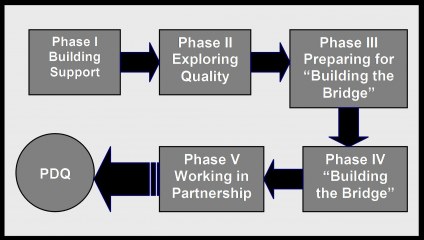
The 4 phases of the process - as undertaken in the 3 countries - are outlined in more detail; they include:
- Phase I: Building Support - explaining the purpose and the benefits of the quality improvement process, as well as the partnership approach.
- Phase II: Exploring Quality - involving participants in organising the information, analysing gaps, and identifying possible solutions to bridge differences between providers and clients, and in developing their final presentations for the next phase.
- Phase III: Building "the Bridge" - team building, developing a shared vision, identifying problems, and selecting members for an advisory committee that would stay involved in the quality improvement process.
- Phase IV: Working in Partnership - sharing the common vision with programmes in each country to help secure buy-in and foster cooperation and respect between the different groups.
Lessons learned include:
- Involving MSM and FSW garnered support for programme activities.
- Building relationships between health providers and the communities they serve is a critical first step in the quality improvement process.
- Good facilitation skills and a high degree of cultural sensitivity throughout the PDQ process are necessary.
- The PDQ process created a forum for vulnerable groups and health providers to voice their concerns, needs, and priorities regarding quality VCT services.
- The PDQ methodology was an effective tool for addressing negative perceptions and practices of providers and vulnerable groups and to begin the process of sensitising all stakeholders to widespread stigma and discrimination.
- Providers were more inclined to collaborate with vulnerable groups than anticipated.
- The PDQ process facilitated open dialogue and consensus building between different perspectives.
- To maintain motivation among advisory committees that result from PDQ, strategies to actively involve the committee in quality improvement are needed.
Email from IRH to The Communication Initiative on March 25 2010; and IRH website, March 26 2010.
- Log in to post comments