










































Singha Durbar (Madam Prime Minister)
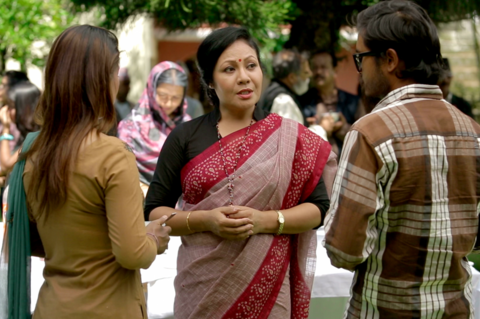
"What if we could create a fictional road map to good governance, firmly rooted in reality, believable, yet reaching for the stars? What if it sparked conversations around the country about how to redefine what good leadership means for Nepal? What if fictional role models could have people nodding, slowly at first, and then more vigorously, saying ‘Yes, we could be this.’?"
Singha Durbar is a 2-year entertainment-education (EE) project that seeks to mitigate public disillusionment and dissatisfaction towards the government and political process in Nepal using multi-media communications and story-telling approaches. Specific project goals include to: increase public knowledge of government functions at the local and national levels and foster constructive citizen-government engagement; foster dialogues at multiple levels to create a shared national vision for leadership and governance; and promote positive role models for leadership and governance through popular culture. Funded by the United States Agency for International Development (USAID), the project is implemented by Search For Common Ground (SFCG) in partnership with the Antenna Foundation, Common Ground Productions, and Mila Productions.
The initiative centres on the production and broadcast of 13-episodes of a political TV drama series, Singha Durbar, and a 52-episode radio drama series, Gaun Gaunma Singha Durbar. The project uses these two media products in addition to think tank events and policy papers to catalyse dialogue among key stakeholders on governance, collaborative leadership, and policy issues in Nepal. By neutralising partisanship and conflicting points of view by portraying issues in the form of a story with the public as observers, the project aims to build trust and promote values of inclusion, transparency, honesty, and collaborative government through good leadership by creating role models. The media products developed will reach citizens in in all 75 districts through local FM stations.
Launched in November 2015 at a premier hosted by Nepal's first female Honorable Speaker of the House, Ms. Onsari Gharti Magar, and the United States (US) Ambassador to Nepal, Her Excellency Alaina B. Teplit, the television drama series stars veteran film actress Gauri Malla as Nepal's first female Prime Minister, Asha (which means hope). How to create a believable character in Asha who could stick to her convictions, and lead authentically in a highly charged, patriarchal environment? To find the answers, the writers and production team met with many Nepali leaders – from government, politics, civil society and media - to hear their visions for what was possible and to draw out their ideas on leadership. Serena Rix Tripathee of SFCG Nepal writes: "It would have been easy to create a drama filled with manipulation, payoffs, backstabbing, corruption and unsolved problems – because that is the picture the daily newspapers give us. But what would that change? What new conversations would it spark? Our role, as peacebuilders, is to stretch the imagination of what is possible. To hear what people yearn for and remind them not to give up on their dreams. To foster agency – that profound realization of the self that anyone can have an impact on their lives, and ultimately on society. To find pockets of hope amid the cynicism. To remind people of their own visions, ethics, and to shine light on the pathway that leads us all to being the best version of ourselves."
Directed by Tsering Rhiter Sherpa, the show focuses on the challenges Asha faces in her quest to establish a governance system of transparency, accountability, and collaborative leadership in a post-constitution Nepal. Topics covered included issues such as climate change, agricultural productivity, poverty reduction, health, corruption, and general principles of good governance. Depicting the inner workings of the central government, the drama focuses on women's leadership in a historic moment for Nepal, right after the election of both its first female Speaker of the House and President. The show tells the story of the inner-workings of the seemingly impenetrable central government of Nepal, humanising the country's politicians and creating role models for an inclusive, transparent and collaborative leadership style. With broadcast complete in February 2016, Singha Durbar used the power of drama to create in its audience a sense of possibility that their government leaders could serve the whole country rather than their narrow political interests. This is expected to increase public understanding of how government works at local and national levels, increase interest in constructive civic engagement, and help identify possibilities for collaborative political culture in Nepal. The mothers' group in the far-western region of Nepal, Getta, Kailali, discuss women's leadership by giving an example of Prime Minister Asha of Singha Durbar TV series. Jasu Devi Bhatta, 55, a member of the Aama Samuha shares, "I have watched Singha Durbar and I feel inspired. I am confident that the reel-life Prime Minister of the TV series will inspire millions of women to take leadership roles." According to organisers, "[t]hese positive ripples prove that the TV series have been effective, and is making people think, and act."
The show's Facebook page serves as a way to inspire discussion of the themes raised within the drama among viewers by posing questions such as: "Do you believe that Singha Durbar TV series imparts hope?" Episodes may be watched on the Madam Prime Minister website.
Parvati Bhandari, 30, the District Governance Expert of the DCC (District Development Committee) of Banke, is a listener of the radio programme Gaun Gaunma Singha Durbar. "She is impressed by the two female characters, that she considers authentic symbols of women empowerment. 'The Superintendent Police and Village Development Committee secretary are strong-willed women, who hold influential positions in the society. These characters overcome social scrutiny with their wits, sheer determination, and self-belief. The message for me after listening to these influential female characters is to believe in oneself, and never give up.'" She strongly believes that the radio drama has the power to battle gender stereotypes, and establish women as positive role models in the society. She is encouraging her colleagues to listen to it, especially her male counterparts, so that they can better understand the challenges that women face in contemporary Nepali society. 'It will not only enlighten them, but also encourage them to be more respectful towards us', concludes Parvati." In June 2015, the Chief District Officer (CDO) of Pachthar, Pradeep Raj Kadel recently participated in the radio show's "Click and tell" social media competition to promote social accountability. His photo portraying a building that is accessible to the disabled and elderly and is child friendly garnered maximum number of Facebook likes.
Democracy and Governance, Women, Gender
Nepal underwent a rapid political transformation since the signing of the Comprehensive Peace Accord (CPA) between the government and the Communist Party of Nepal (CPN)-Maoist in November 2006. After missing deadlines of the first historic Constituent Assembly (CA) to complete its mandate and its 2012 dissolution, concern remained about the second CA's – elected in November 2013 - ability to produce a constitution by the early 2015 deadline. This concern stemmed largely from the impasse among political leadership during the first CA over a number of key issues, including state restructuring based on a federal system, local government elections, and the Truth and Reconciliation Commission. As a result, public perceptions of political leadership and the government became increasingly negative.
Funded by the United States Agency for International Development (USAID), the project is implemented by Search For Common Ground (SFCG) in partnership with the Antenna Foundation, Common Ground Productions, and Mila Productions.
Madam Prime Minister website, SFCG website, USAID website, and Singha Durbar Facebook page - all accessed on March 15 2016; and email from Ayush Joshi to The Communication Initiative on June 17 2016.
- Log in to post comments