










































Do Social Norms Influence Young People's Willingness to Take the COVID-19 Vaccine?
Linnæus University
"...the practical usefulness of signaling descriptive norms is rather limited, and may not be more effective than standard appeals in the quest of encouraging young adults to trust and accept a new vaccine."
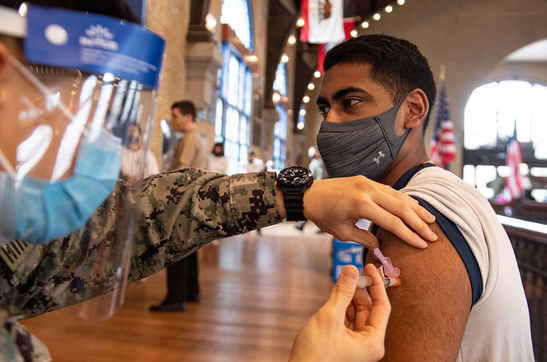
Because of our inherently social nature, human beings tend to be attentive to cues about which behaviours, attitudes, and values that are acceptable among most people. Young people may be particularly susceptible to social influences on vaccine attitudes, considering they frequently use social media and tend to go online to seek health information. In that context, this study reports on an online experiment that examined whether communicating descriptive social norms - information about what most people do - is an effective way of influencing young people's intentions and reducing their hesitancy to take the COVID-19 vaccine. Notably, although young adults are not at great risk of becoming severely ill with COVID-19, their willingness to get vaccinated affects the whole community.
Previous studies reviewed here indicate that the tendency to be influenced by perceptions of what others do should be especially likely when one identifies with, or feels similar to, the (norm) reference group. Thus, apart from a general effect of norms, the researchers expected to find that young people are particularly influenced by descriptive norms when the reference group consists of their own age group.
The study was conducted in the United Kingdom (UK), which has suffered greatly from the pandemic. The data were collected at a time (end of December 2020) when the first vaccine had just started to be administered. Thus, the decision to take or refrain from the vaccine was imminent at the time, and it concerned everyone.
The participants, who were 18-30 years old and resided in the UK, were randomly assigned to one of six experimental conditions, with information indicating one of the following: (i) "It is now estimated that among people in general, 85% plan to take the vaccine against the coronavirus"; (ii) "It is now estimated that among people in general, 45% plan to take the vaccine"; (iii) "It is now estimated that among people who are 18-30 years old, 85% plan to take the vaccine"; (iv) "It is now estimated that among people who are 18-30 years old, 45% plan to take the vaccine"; (v) "The National Health Service (NHS) declares that the coronavirus vaccine is safe and effective and that it gives you the best protection against the coronavirus"; or (vi) [a baseline condition where no information about the vaccine was provided, and no mention was made about other people's plans].
Among the final sample of 654 participants, the test revealed weak support for the hypothesis that conveying strong (compared to weak) norms - 85% in the conditions above - leads to reduced hesitancy and stronger intentions. Furthermore, norms did not produce significantly different effects compared to standard vaccine information from the authorities [NHS - condition (v)]. Moreover, no support was found for the hypothesis that young people are more strongly influenced by norms when the norm reference group consists of other young individuals [conditions (iii) and (iv) above] rather than people in general.
In exploring the findings, the researchers note that vaccination is a relatively private and less visible behaviour compared to other protective behaviours during the pandemic, such as wearing face masks. It is thus possible that people's awareness of whether vaccine hesitancy is common or not is quite low - so norms might not have as much effect in the case of vaccines. However, "it seems plausible that for those who (erroneously) believe that few people intend to take the vaccine, and for those who are unaware of how common pro-vaccine attitudes are, correcting misperceptions could be worthwhile."
Also, the researchers speculate that the reason for the lack of expected interaction between norm strength and reference group could be that the participants did not identify strongly with their age group. In light of this finding, the researchers do not recommend that norm messages are tailored for specific age groups.
Overall, based on this investigation, the researchers do not recommend investment in resources to support communicating norm information at the expense of other types of promising messages, such as those that focus on vaccine safety. "However, multiple messages sometimes produce stronger effects on health-related intentions..., and perhaps combining messages from health authorities with norm messages would produce stronger effects on intentions and hesitation. Similarly, it is possible that combining descriptive and injunctive norms are more effective...; future research could explore these possibilities."
Health Communication, DOI: 10.1080/10410236.2021.1937832. Image credit: MC2 Nathan Burke via Flickr. Public domain 1.0
- Log in to post comments