










































CDC's Health Communication Wheel
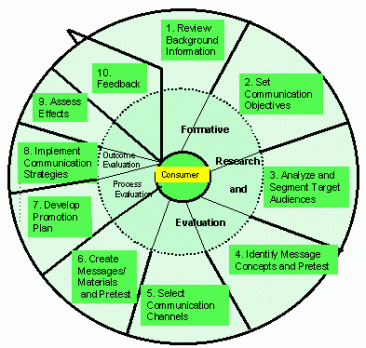
From the March-April 1993, Vol. 106, No. 2 181 publication"Policy", this article entitled "Health Communication Takes on New Dimensions at CDC" of Dr. William L. Roper, of the Centers for Disease Control and Prevention (CDC), United States, describes the health communication wheel: "For implementing health communication programs at CDC, there is a framework based on 10 action steps. These 10 steps, depicted in the chart, follow:
- Review background information (What's out there?). Environmental scanning is a term used in marketing to describe the monitoring and assessing of factors, within an organization and outside of it, which will affect successful planning and implementation of a project. At CDC some environmental scanning techniques include disease surveillance, trend extrapolation, and monitoring of the scientific and mass media. Results of environmental scanning can assist in making specific decisions about the scope and focus of the health communication component of a prevention program. The review of relevant policy and planning documents, as well as any goals and objectives drafted for the overall prevention program, will be essential to plan an effective health communication effort.
- Set communication objectives (What do we want to accomplish?). When a prevention program has been identified, its goals and purposes clarified, and the role of health communication defined, the context is established for setting communication objectives. Health communication objectives must be clear, time-specific, measurable, and attainable. They also should identify the optimal combination of communication methods and channels and articulate the expected results of the communication activity. The health communication objectives-to promote changes in awareness, knowledge, attitudes, beliefs, and, if appropriate, changes in certain behaviors-should support, and be derived from, the goals and objectives of the total prevention program.
- Analyze and segment target audiences (Whom do we want to reach?). Careful audience analysis will help develop relevant messages and materials and to identify the channels most likely to reach and influence target audiences. The goal of audience segmentation is to identify the largest possible groups of people (among those affected by the issue) sharing key attributes that affect their attentiveness and response to a health issue and message. For some issues and messages, it may be sufficient to segment physical characteristics (for example, exposure to health risks) and demographic and cultural characteristics (for example, age, sex, race) alone; for others, it may be appropriate to consider characteristics such as behaviours (for example, smoking habits, exercise patterns), communication channels used (for example, specific radio stations or magazines), and psychological characteristics (for example, attitudes, values, opinions).
- Develop and pretest message concepts (What Mach-April 1993, Vol. 106, No. 2 181 do we want to say?). Formative research and evaluation are essential to determine what health message ideas or concepts will "connect" with the target audience and influence health choices. Literature review, in-depth interviews, and focus groups are examples of formative research which can be helpful in identifying key message concepts. For example, in determining what might prevent adolescents from starting to smoke cigarettes, formative research may indicate that message concepts related to the value of personal relationships and athletic performance, not long-term concerns about health, have been effective. Therefore, "Smoking affects athletic performance" and "Smoking is not compatible with being popular" might become two initial message concepts to be tested. A combination of formative research ("pretest") techniques can be used to help determine if one concept is more salient to adolescents than another, and which concepts should be developed into specific messages. The general approach to pretesting concepts is to share them with members of the target audience and gauge the reaction.
- Select communication channels (Where do we want to say it?). Determining the optimal combination or "mix" of channels through which to send a specific health message is based on (a) consideration of the information habits of the target audience (the sources from which targeted audiences seek or receive news, other information and entertainment, or both). Such research will reveal which channels are credible and accessible to the target audience; (b) the concept of the message. Electronic media, for example, convey brief, simple, motivational messages well, while print media or other sources might be better to convey indepth, complex information; and (c) the timeline and budget for a communication activity. Use of different but appropriate channels takes advantage of strengths of each channel and minimizes the risk that a single channel will "miss" a large part of the audience. A good mix of channels increases the opportunities for the target audience to be exposed to the message a sufficient number of times to absorb and remember it.
- Create and pretest messages and products (How do we want to say it?). After selection of the best mix of channels to reach a target audience, it is necessary to choose communication formats to fit the channels (for example, brochure, public service announcement, poster). Communication format, in turn, will affect the content and delivery of messages. For example, references to specific high-risk sexual practices may be acceptable for a brochure distributed through health clinics but not for a public service ad shown on commercial TV. Crafting of specific messages follows determination of message concepts that are most important for the prevention program and are motivational to the target audience. Pretesting of the messages for effectiveness is done while materials are in draft form to allow changes to be made without great expense if testing reveals ways to improve the messages or materials. Methods for pretesting include "intercept" interviews with members of the target audience (brief interviews on the street or at a central location such as a school or shopping mall) and focus groups. Pretest results should be used to revise messages and materials before proceeding with "finished" products.
- Develop promotion plan/production (How do we get it used?). Developing a sound promotion plan for a communication activity is critical to ensure that it reaches its intended audiences and is not "lost in the ether." The framework for the promotion plan should be tied to the communication objectives in the context of the broader prevention program. A comprehensive promotion plan should describe target audiences and channels, describe activities and events to promote and broaden the communication effort, describe methods to disseminate materials, describe mechanisms to store and track quantities of materials used and those remaining, describe logistical support for all of the above tasks, and provide an implementation timetable.
- Implement communication strategies and conduct process evaluation (Let's do it!). Careful research and planning throughout the process of developing a communication component sets the stage for action. Communication activities take place through all appropriate media and organizational channels, timed to support other elements of the prevention program (for example, support services, community outreach efforts). Evaluation does not end with implementation. Process evaluation is needed to determine if mass media and 182 Public HeaIth Report organization "gatekeepers" are active in the communication activities, if messages and materials are reaching target audiences, and if the overall activity is proceeding on time, on strategy, and within budget. Process evaluation can also provide measures of message dissemination and exposure, using techniques and services such as clipping services, public service monitoring reports, "bounceback" cards, surveys, and measures of calls to hotlines or changes in inventory.
- Conduct outcome and impact evaluation (How well did we do?). Process evaluation measures how well messages, materials, and activities were implemented and received by target audiences. Impact and outcome evaluation seeks to measure the effects of the communication activity on the target audiences. The terms "impact" and "outcome" are used differently by different evaluation experts; for CDC's purposes, outcomes are short-term effects and impacts are long-term effects. Both levels of evaluation measure changes in awareness, knowledge, attitudes, and behaviors attributable to the communication activity. This phase of evaluation is the most difficult and most costly. In a comprehensive prevention program, it can be difficult to separate the effects of health communication from the effects of other elements of the program. Outcome and impact evaluation may be less necessary for programs that test the effectiveness of messages and strategies through extensive formative research and evaluation and then track the dissemination and reception of messages through rigorous process evaluation. Even in the absence of outcome and impact data, formative research combined with process evaluation should give some indication of the likelihood of success of the communication activity.
- Feedback to improve communication (Where do we go from here?). Feedback from evaluating the effectiveness of health communication activities can help identify both strengths and weaknesses and suggest a course of action for improving the activities where necessary. By design, feedback is ongoing and action-oriented. It should lead to improved decisions about effective use of communication in both the planning and implementation of prevention programs."
Source
Centers for Disease Control and Prevention, Atlanta, Georgia, United States.
- Log in to post comments